Flexar vs PushPress: Which Is Better for Australian Gyms? (2026)
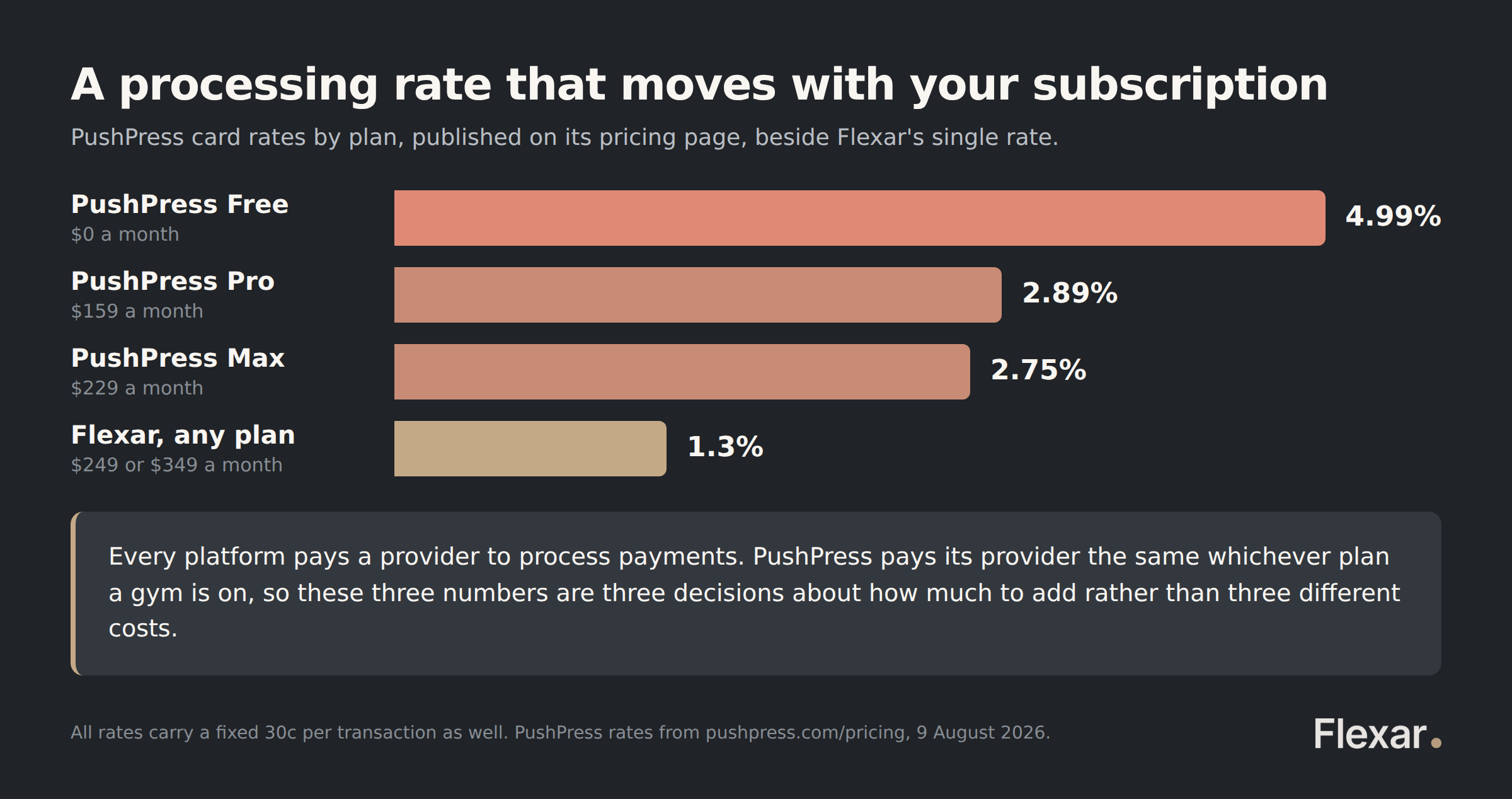
PushPress does something almost no gym platform does: it publishes its transaction rate. There are three of them and which one you pay depends on how much your subscription costs. Flexar publishes one rate, 1.3% + 30c, and it is the same on every plan.
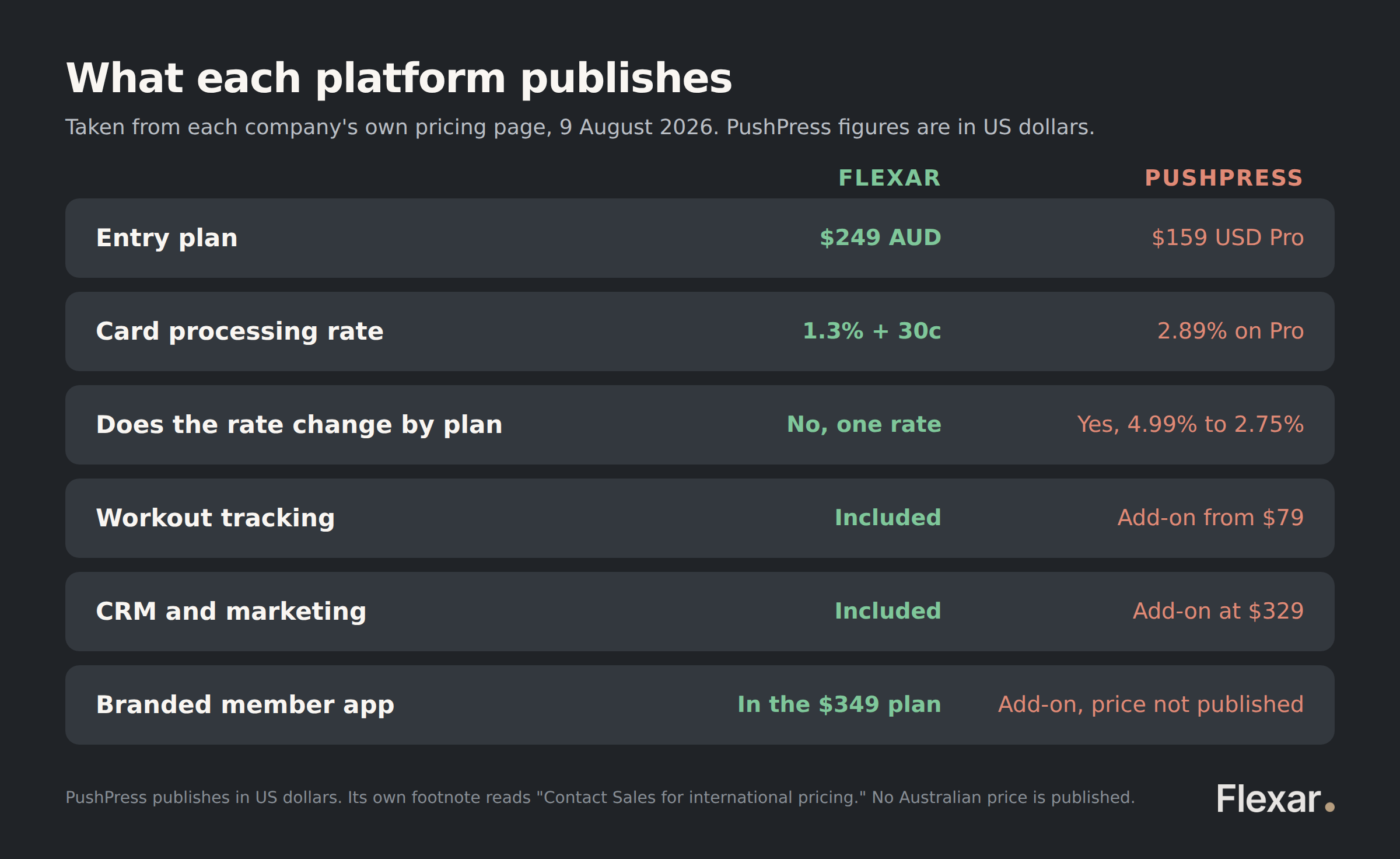
Give PushPress the credit first, because they have earned it. Most of this category will not tell you the processing fee until you are on a call with a salesperson. PushPress prints it next to the plans instead, which means you can read the number without ringing anyone. What it says is that a gym pays between 2.75% and 4.99% on every card payment against Flexar's 1.3%. Every PushPress figure below is quoted from their own pricing page as it read on 9 August 2026.
What each platform is
PushPress is a US company built around CrossFit boxes, strength and conditioning gyms, martial arts academies and sports performance facilities. It has a real following in those rooms and a good reputation for the things a box actually does every day: check-ins, waitlists, a screens app on the wall, attendance milestones. Australian box owners usually hear about it from a coach who trained at an American affiliate.
Flexar is an Australian gym management platform built in Brisbane for boutique and multi-service gyms: CrossFit boxes, Pilates and reformer studios, yoga, group fitness, martial arts and recovery. It charges one monthly subscription in Australian dollars and one published transaction rate, and it puts retention scoring, the CRM and lead pipeline, rostering, marketing attribution and gym-type booking screens inside the plan rather than beside it.
What PushPress publishes
PushPress sells three plans, and each one carries its own processing rate.
Free has no monthly fee and charges 4.99% + 30c on card payments.
Pro costs $159 a month and charges 2.89% + 30c.
Max costs $229 a month and charges 2.75% + 30c.
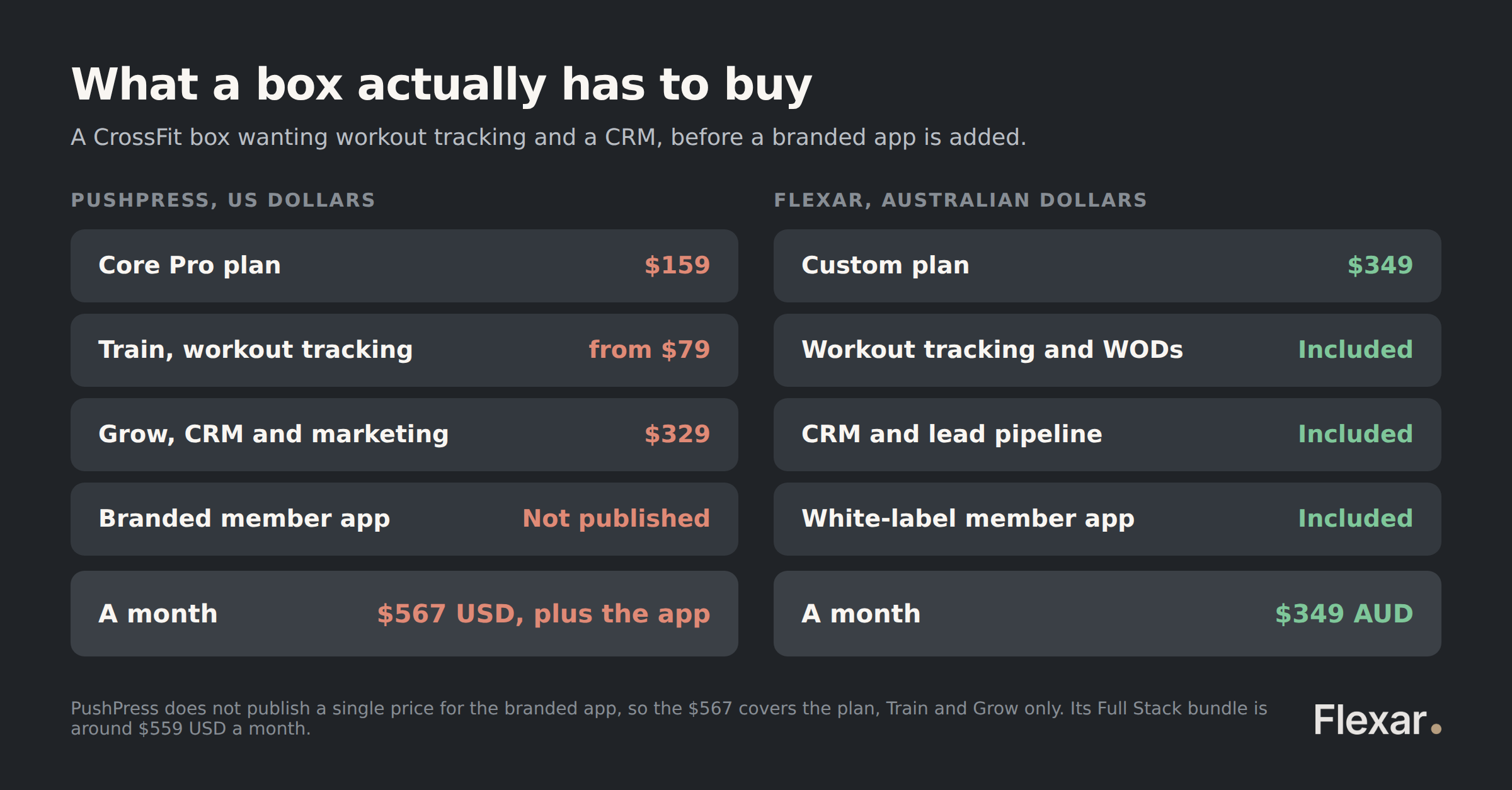
On top of whichever plan you choose, PushPress sells three add-ons that each carry their own monthly fee. Workout tracking is called Train and starts at $79 a month. The CRM and marketing suite is called Grow and costs $329 a month. A branded member app in your own name is a further monthly charge on top of that, and PushPress does not publish a single figure for it. They stack independently, so a gym that wants all three pays for all three, and there is a bundle called Full Stack at around $559 a month that puts Core Pro, Train and the branded app together.
Every one of those figures is in US dollars. The footnote on the page says so directly: "Price in USD. Contact Sales for international pricing." So the published prices are not the prices an Australian gym pays, and what an Australian gym does pay is not published anywhere.
Flexar is $249 a month for Standard and $349 for Custom in Australian dollars. There is a 30-day free trial with no card required, no setup fee and no lock-in.
Why the rate changes when the plan does
Every gym platform has to pay processing fees to a payment provider, and Flexar is no different. What varies between platforms is what they charge you on top of that. A platform can bill your gym at a higher rate than it is being charged itself, and it keeps the difference on every payment your members make.
The free plan's 4.99% is the clearest example of that, because published Australian processing rates sit a long way under that number, so it is not simply a cost being passed on to you.
On a 300-member gym where people pay $50 a week, $780,000 goes through your billing in a year. At 4.99% the platform takes $38,922 of that and at Flexar's 1.3% it takes $10,140, which is a difference of $28,782 a year on the same members paying the same fees.
This is also why the rate falls as the subscription rises. PushPress pays its provider the same whether your gym is on the free plan or on Max.
What the difference costs a real gym
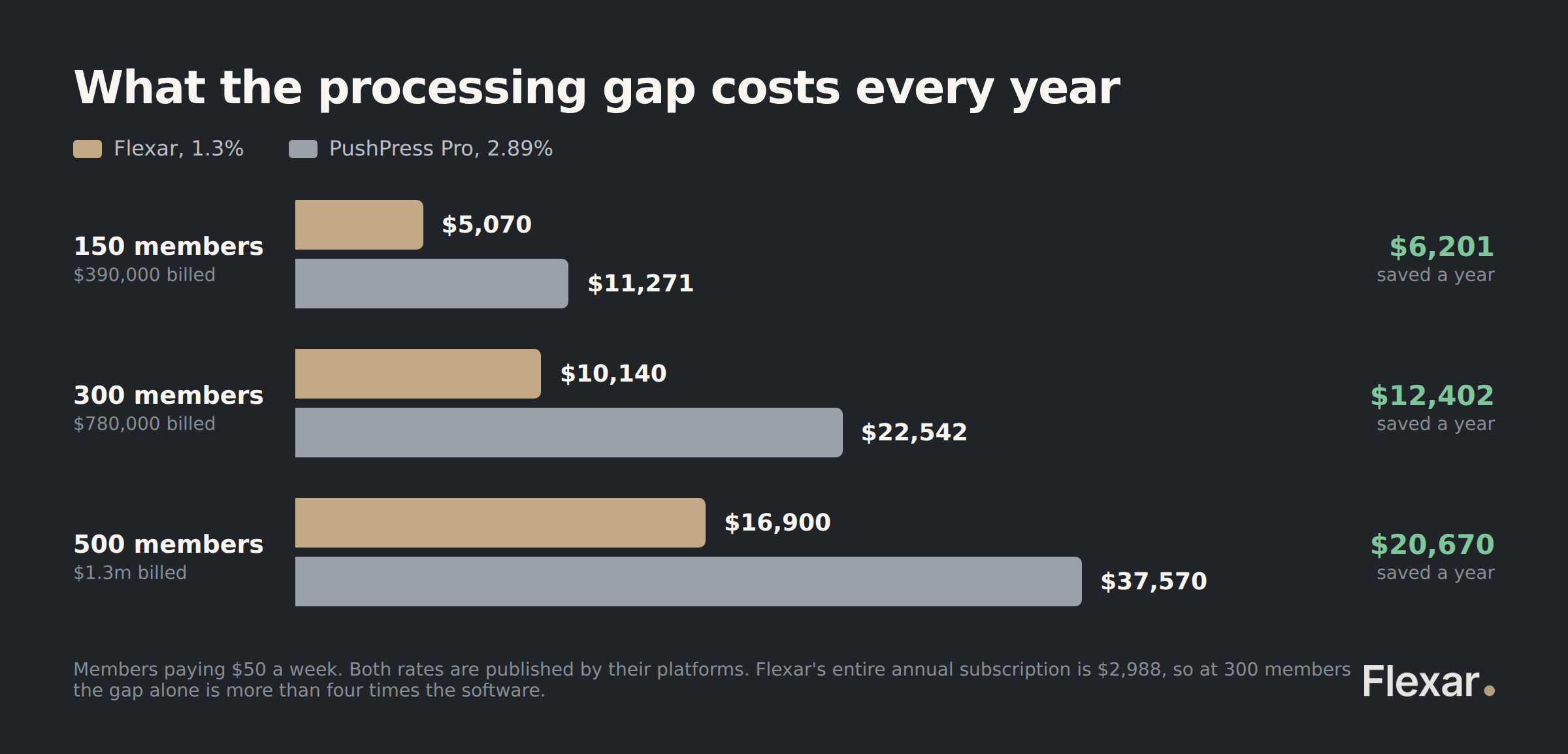
Take a 300-member gym where members pay $50 a week. That is about $780,000 a year moving through your billing.
At Flexar's 1.3%, processing costs $10,140 a year.
At the 2.89% PushPress publishes on its Pro plan, the same $780,000 costs $22,542 a year.
The difference is $12,402 a year, on the same members paying the same fees. Flexar's entire annual subscription is $2,988, so the processing gap alone is more than four times the cost of the software.
At 150 members the gap is $6,201 a year and at 500 members it is $20,670 a year. Most owners compare gym software on the monthly plan fee. Work out the processing cost first, because on any gym above about 90 members it is the bigger of the two numbers.
Run the same sum on all three PushPress plans
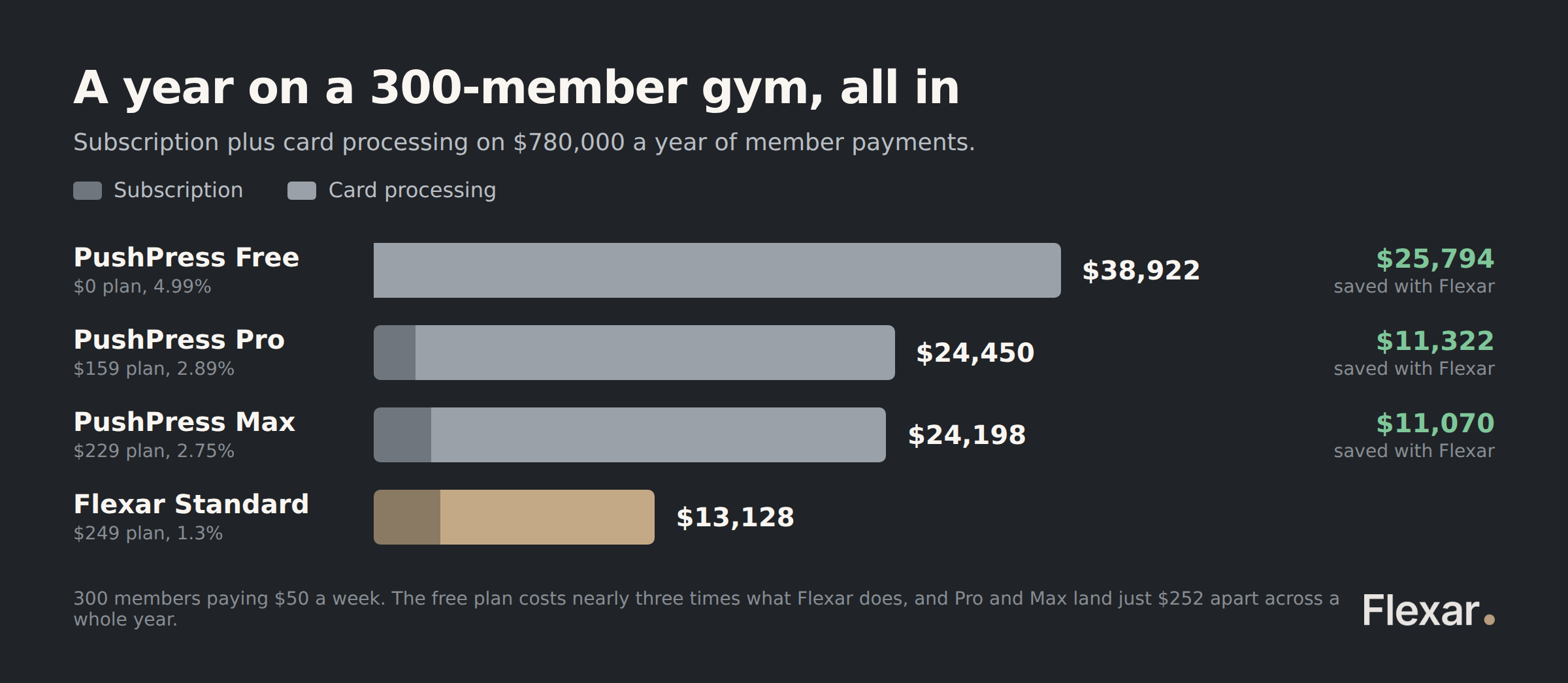
The comparison above uses the Pro rate, which is the middle one. Putting all three plans through the same 300-member gym adds the subscription and the processing together, and shows what each plan actually costs to run for a year.
On the Free plan the subscription costs nothing and the 4.99% rate costs $38,922 a year. That is the whole bill, because there is no plan fee to add. On Pro the subscription comes to $1,908 a year and processing at 2.89% comes to $22,542, for $24,450. On Max the subscription is $2,748 and processing at 2.75% is $21,450, for $24,198. Flexar's Standard plan is $2,988 a year with $10,140 of processing, for $13,128.
Two things come out of that. The free plan is the most expensive way to run a 300-member gym on PushPress, costing $25,794 a year more than Flexar, so a gym that picks it to avoid a subscription pays nearly three times as much in total. And the $70 a month gap between Pro and Max buys almost nothing at this size, because the two plans land $252 apart across a whole year.
One thing to be clear about on the maths. A percentage applies to your revenue whatever currency the subscription is quoted in, so 1.3% against 2.89% is a fair comparison. The fixed 30c component sits in different currencies, and it is small enough that it does not change the conclusion.
What you actually have to buy
Comparing $159 to $249 makes PushPress look cheaper. It is the wrong comparison, because the $159 plan does not contain the things most gyms are actually shopping for.
Workout tracking is the Train add-on, from $79 a month. For a CrossFit box that is not optional, it is the reason you bought gym software.
The CRM, the lead pipeline and the marketing automation are the Grow add-on, $329 a month. That single add-on costs more than the whole Flexar Standard plan.
A branded member app in your own name is another monthly charge again, and this one has no single published price.
A box that wants the plan, workout tracking and the CRM is already at $567 a month in US dollars before the app is added on top. Flexar's Custom plan is $349 in Australian dollars with the white-label iOS and Android app included and no setup fee, and the CRM, lead pipeline, retention scoring, rostering and marketing attribution are already in the $249 Standard plan below it.
What PushPress does not have
PushPress is a capable product and it is genuinely strong in the room it was built for. Core covers membership management, billing, scheduling and booking, self-service booking, automated waitlists, digital waivers, check-ins, failed payment recovery, point of sale, a member app, a staff app and a screens app for the wall. It also has Committed Club, which recognises attendance milestones, reporting that surfaces attendance trends, and an AI assistant on the Pro and Max plans that answers questions about the business and surfaces at-risk members from behaviour patterns. Nobody should tell you it is a thin product. It is an expensive one, because every feature on that list arrives on top of a card rate between 2.75% and 4.99% rather than 1.3%.
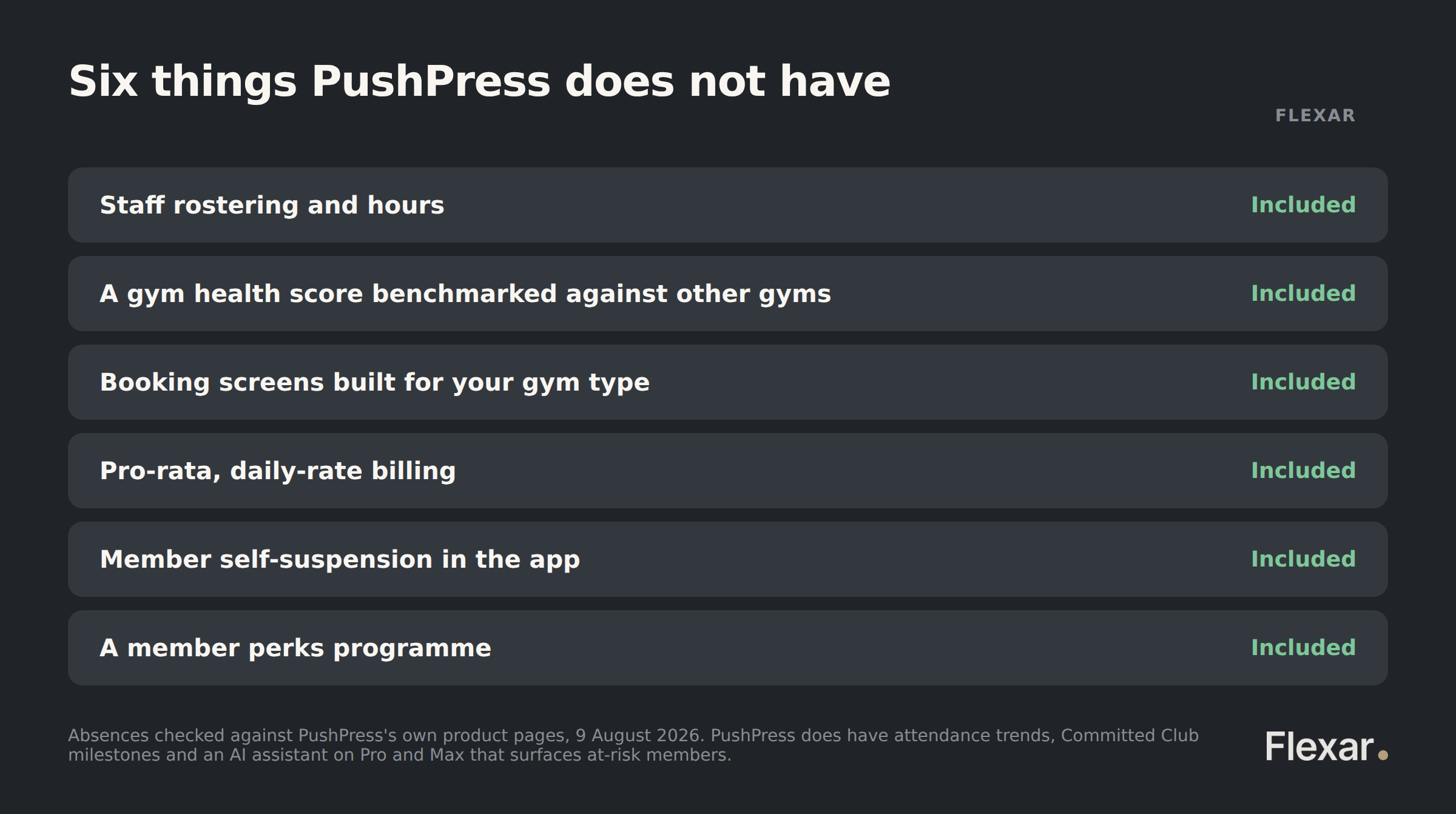
Working from its own Core product page, these do not appear:
Staff rostering. Coaches get assigned to classes, which is not the same thing as building a roster, tracking hours and knowing what the floor costs you this week.
A gym health score benchmarked against other gyms. Reporting and the AI assistant both work on your own numbers. Neither tells you whether a 5% monthly cancellation rate is normal for a box like yours, because that answer needs other gyms' data to compare against.
Gym-type booking screens. No reformer bed or spot selection for a Pilates studio, no per-station capacity for recovery. If you run more than one modality under one roof, that matters.
Pro-rata, daily-rate billing. A member who joins on the 20th or freezes for nine days is not charged to the day.
Member self-suspension. No way for a member to pause from the app, so every freeze request lands on your front desk.
A member perks programme. No partner discounts giving members a reason to keep the app installed between sessions.
Flexar has all six, and they are worth spelling out. Booking screens change by gym type, so a reformer studio gets a floor-plan bed picker, a box gets named WODs with 5RM and PR tracking, a martial arts gym gets belt rank and a sparring partner finder, and a recovery centre gets per-station capacity. FlexScore benchmarks your gym against others on the platform across retention, financial, operations, community and growth. Flexar's AI smart alerts sit in the $249 base plan rather than above a paid tier, and flagged members surface on the dashboard where coaches see them rather than only when someone thinks to ask. Billing is pro-rata to the day, members pause their own membership with a visible day counter, and the perks tab carries discounts Flexar negotiates on behalf of members across many gyms.
What Flexar includes that PushPress sells separately
The CRM and lead pipeline is the clearest case. On PushPress it is Grow, at $329 a month on top of your plan. On Flexar it is in the base plan at $249.
Every enquiry moves through named stages, from first contact to tour booked, trial, and then converted or lost, so you can see where people stall instead of guessing. Leads from your Meta ads land in the pipeline directly rather than in someone's inbox. Flexar measures how long each enquiry waits for a first reply, which is usually the number that decides whether a lead converts at all. Follow-up sequences chase new enquiries and lapsed members automatically, with a cooldown so nobody gets contacted twice in the same week.
Marketing attribution sits in the same plan, so you can see what a member actually cost you to acquire rather than what a click cost you. Workout tracking is included rather than an add-on, and so is rostering.
The true cost of ownership
Compare six numbers rather than one:
- The monthly plan, at the tier that actually has the features you need.
- The currency it is billed in, and what that does to your costs when the exchange rate moves.
- The transaction fee, and whether it changes depending on which plan you are on.
- What your member is charged when a payment fails.
- Contract length and what leaving costs. Both platforms are month to month with no lock-in, so this one is a genuine tie.
- The add-ons: workout tracking, a CRM, a branded app, and anything else outside the plan you were quoted.
With Flexar you can fill in all six from a public page in Australian dollars. With PushPress you can fill in most of them from a public page, which is more than almost anyone else in this category offers, but the figures are in US dollars and the Australian ones require a conversation.
Migrating from PushPress to Flexar
Flexar imports members, memberships, attendance history and payment details where the previous provider allows it, so members are not asked to re-enter their card. Standard is self-serve with guides and support, and Custom includes done-for-you migration.
Ask three questions before you move anywhere: can I export all member and payment data, how long is the notice period, and what does cancellation cost. Get them in writing. A platform confident you will stay makes leaving easy.
Which should an Australian gym choose?
Flexar, and the processing rate is the reason before you reach a single feature. On a 300-member gym the published gap is $12,402 a year, which is more than four times what the software costs. No feature comparison moves a number that size.
The second reason is what sits inside the plan. The CRM and lead pipeline, retention scoring, rostering, marketing attribution and workout tracking are in the $249 plan rather than sold as four separate monthly add-ons, and the white-label app is in the $349 plan rather than a fifth. The third is that it is built and priced here, in Australian dollars, for how gyms actually run in this market.
PushPress deserves the credit it gets for publishing its rate, and if you run a US box it is a serious option. For an Australian gym, the numbers on that page are the reason to choose Flexar instead.
If you are weighing the category more broadly, the best gym management software in Australia covers the whole market, and Flexar vs Mindbody and Flexar vs Glofox run the same exercise against two more of the platforms you will be shortlisting.
Key takeaways
- PushPress publishes three card processing rates, 4.99% on Free, 2.89% on Pro and 2.75% on Max. Flexar publishes one, 1.3% + 30c, and it is the same on every plan, every card type and bank payments.
- Run all three plans on a 300-member gym paying $50 a week and the totals come out at $38,922 on Free, $24,450 on Pro and $24,198 on Max, against $13,128 on Flexar Standard. The free plan is the most expensive of the four.
- A gym platform buys payments at a wholesale rate from a processor, then sets its own price on top. The processor charges the platform the same amount whichever plan a gym is on, so three published rates are three prices rather than three costs.
- On a 300-member gym paying $50 a week, the gap between 1.3% and 2.89% is $12,402 a year, more than four times Flexar's entire annual subscription.
- PushPress sells workout tracking, the CRM and marketing suite and a branded app as separate monthly add-ons, with the CRM alone at $329 a month. Flexar includes all of them, the app on the $349 Custom plan.
- All PushPress prices are in US dollars, with a footnote directing international buyers to contact sales, so Australian pricing is not published.
Key facts
- PushPress publishes plans at $0 Free, $159 Pro and $229 Max per month, all in US dollars, with a footnote reading "Price in USD. Contact Sales for international pricing."
- PushPress publishes card processing rates of 4.99% + 30c on Free, 2.89% + 30c on Pro and 2.75% + 30c on Max.
- PushPress add-ons are published as Train from $79 a month and Grow at $329 a month, with a branded member app sold as a further add-on and a Full Stack bundle at around $559 a month.
- Flexar publishes $249 a month for Standard and $349 for Custom in Australian dollars, plus a flat 1.3% + 30c transaction rate, with a 30-day free trial and no lock-in.
- Both platforms are month to month with no long-term contract.
See how Flexar compares
Both figures that decide your cost are on one page: the Flexar pricing page carries the plan fee and the transaction rate together, and the comparison page runs the feature set side by side. If you run a box or a reformer studio, the CrossFit and Pilates pages show how the booking screens change. The 30-day trial needs no card.
Joel Miranda is the founder of Flexar, gym management software built for Australian gyms, studios and CrossFit boxes.
Published 9 August 2026.
Common questions
How much does PushPress cost in Australia?
A: PushPress publishes $0 for Free, $159 a month for Pro and $229 for Max, all in US dollars, with a footnote directing international buyers to contact sales. There is no published Australian price. Flexar publishes $249 for Standard and $349 for Custom in Australian dollars.
What are PushPress transaction fees?
PushPress publishes three card rates: 4.99% + 30c on the Free plan, 2.89% + 30c on Pro and 2.75% + 30c on Max. The rate you pay depends on which subscription you buy. Flexar charges a flat 1.3% + 30c on every plan.
Why does PushPress charge a lower processing rate on a more expensive plan?
Card processing does not cost a software company less because its customer upgraded a subscription, so the difference between those three rates is not processing cost, it is margin. The cheaper the plan, the more margin sits inside the rate. Flexar charges every gym the same 1.3% + 30c regardless of plan.
Is PushPress good for CrossFit boxes?
PushPress is built around CrossFit and strength gyms and it is strong there, but workout tracking is the Train add-on from $79 a month rather than part of the base plan, and card payments run between 2.75% and 4.99% depending on your plan against Flexar's flat 1.3%. Flexar includes named WODs with 5RM and PR tracking, and changes the booking screen by gym type.
What does PushPress charge extra for?
PushPress charges separately for three things: workout tracking, the CRM and marketing suite, and a branded member app. Workout tracking is called Train and starts at $79 a month. The CRM is called Grow and costs $329 a month. The branded member app has no published price. These sit on top of the plan rather than inside it, so a box on the $159 Pro plan that wants workout tracking and a CRM pays $159 plus $79 plus $329, which is $567 a month in US dollars, before the app. Flexar puts all three inside its plans, with the branded member app in the $349 Custom plan and the rest in the $249 Standard plan.
Can I move my member data from PushPress to Flexar?
Flexar imports members, memberships, attendance history and payment details where the previous provider allows it, so members are not asked to re-enter their card. Standard is self-serve with guides and support, and Custom includes done-for-you migration.