Best Gym Management Software in Australia (2026 Comparison)
Quick answer: Flexar is the best gym management software in Australia. It includes more than 65 features at $249 a month, charges a flat 1.3% + 30c with no margin on top of card processing, adds no platform dishonour fee, and has no lock-in contract.
That makes it my pick for Australian CrossFit boxes, Pilates and reformer studios, yoga, group fitness, martial arts, recovery studios, 24/7 access gyms and multi-location operators. Most owners compare gym software on the monthly price. That number leaves out the two costs that usually matter more: what the platform takes from each member payment, and what you have to buy separately because it isn't included. This article explains what those costs are, how to check them for any platform, and the questions to put to a vendor before you sign.
What gym management software actually does
Gym management software handles the jobs that repeat every day. It stores your memberships, takes class and appointment bookings, runs the recurring billing and direct debits, checks members in at the door, and reports on how the gym is tracking. Most platforms also give members an app to book classes and manage their own membership.
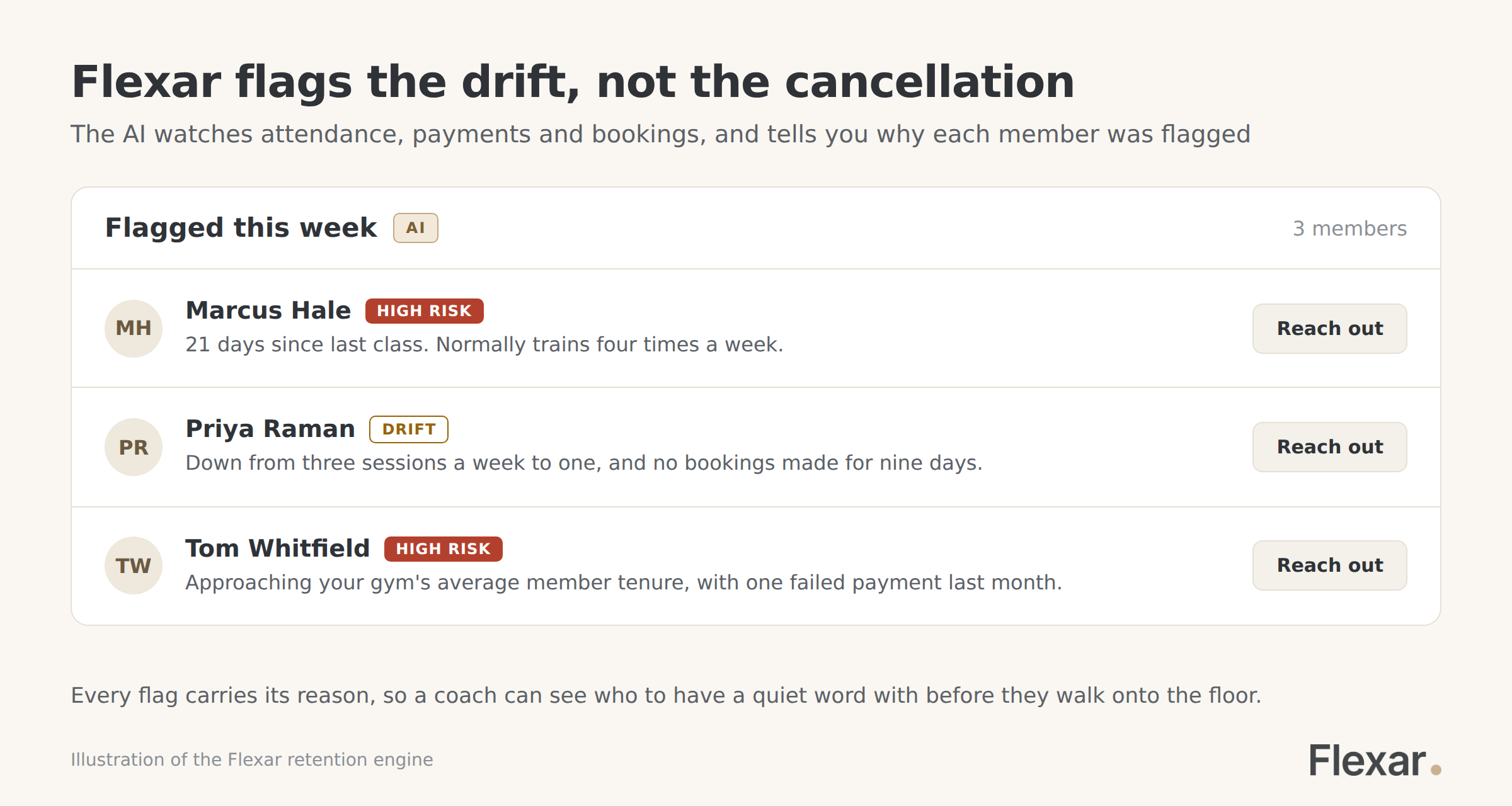
Where platforms really differ is retention, which is simply whether the software helps you keep the members you already have. Most of them only record what happened. Say a member who trains three times a week stops booking: nothing is watching the attendance data, so you find out when the cancellation email arrives. Flexar compares each member's attendance against their own normal pattern and flags them when it drops, so you can message that member the same week rather than a month later.
How to choose gym software
Three things separate a platform that helps your gym from one that quietly costs you: which features are actually included, what it does to your payments, and what the contract locks you into.
Check what is included, not just the price
Two platforms can both charge $150 a month and cost hundreds of dollars apart, because one includes the tools you need and the other sells them as add-ons. Before you look at any price, write down the features you need, and then check exactly which features are in the tier you are being quoted, because the same platform's cheaper tier often leaves out reporting, automation or the member app, and you will not find that out until you need them.
The features worth checking first are the ones that affect revenue. A retention tool that watches attendance and flags members who are drifting does the work described above. A published, flat payment rate tells you what you keep on every membership. Staff rostering, a member app, digital waivers and a perks program included in the plan mean you are not paying three other subscriptions on the side. After that, check the booking screens, because a reformer studio, a CrossFit box and a martial arts academy each set a class up differently.
Work out what the platform takes from each payment
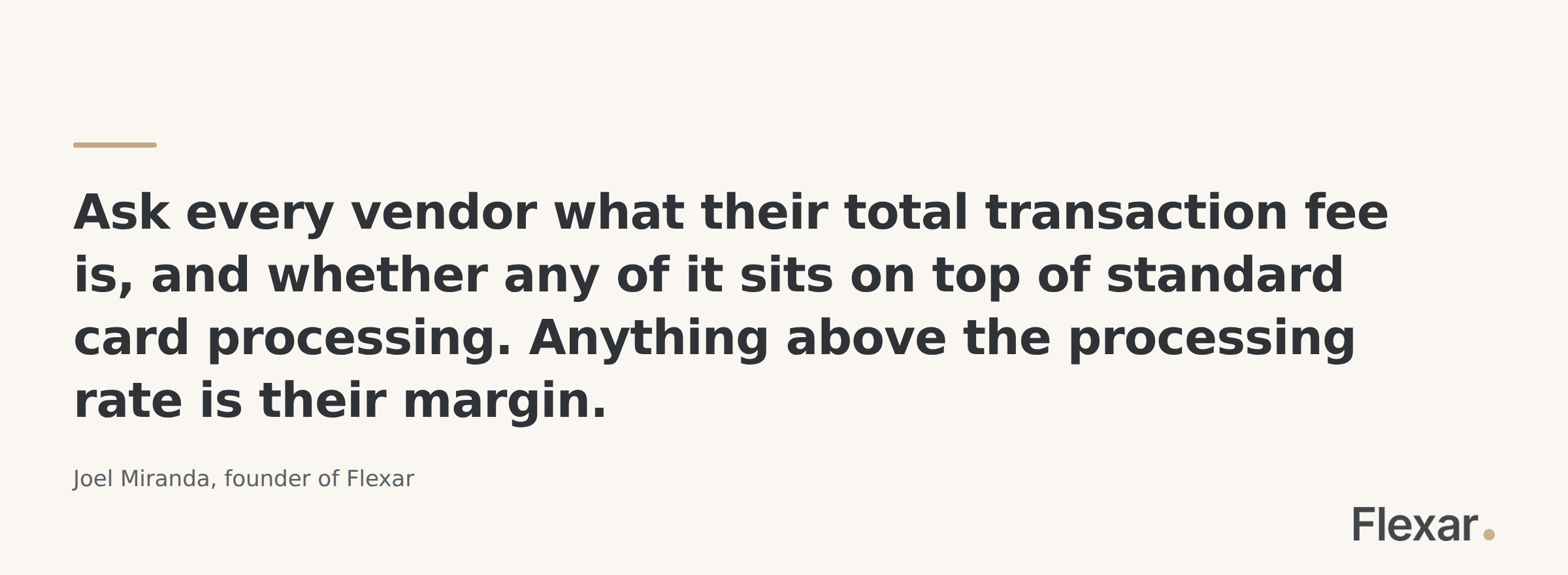
Every platform has a card processing cost, which is normal and unavoidable. The number to find is the margin a platform adds on top of it. Ask each vendor in writing: what is your total transaction fee, and is any of it added on top of standard card processing? Anything above the standard processing rate is the platform's own margin, and it commonly runs 1% to 3% on top of standard card processing fees, which pushes the real cost of taking a payment to between 3% and 5%.
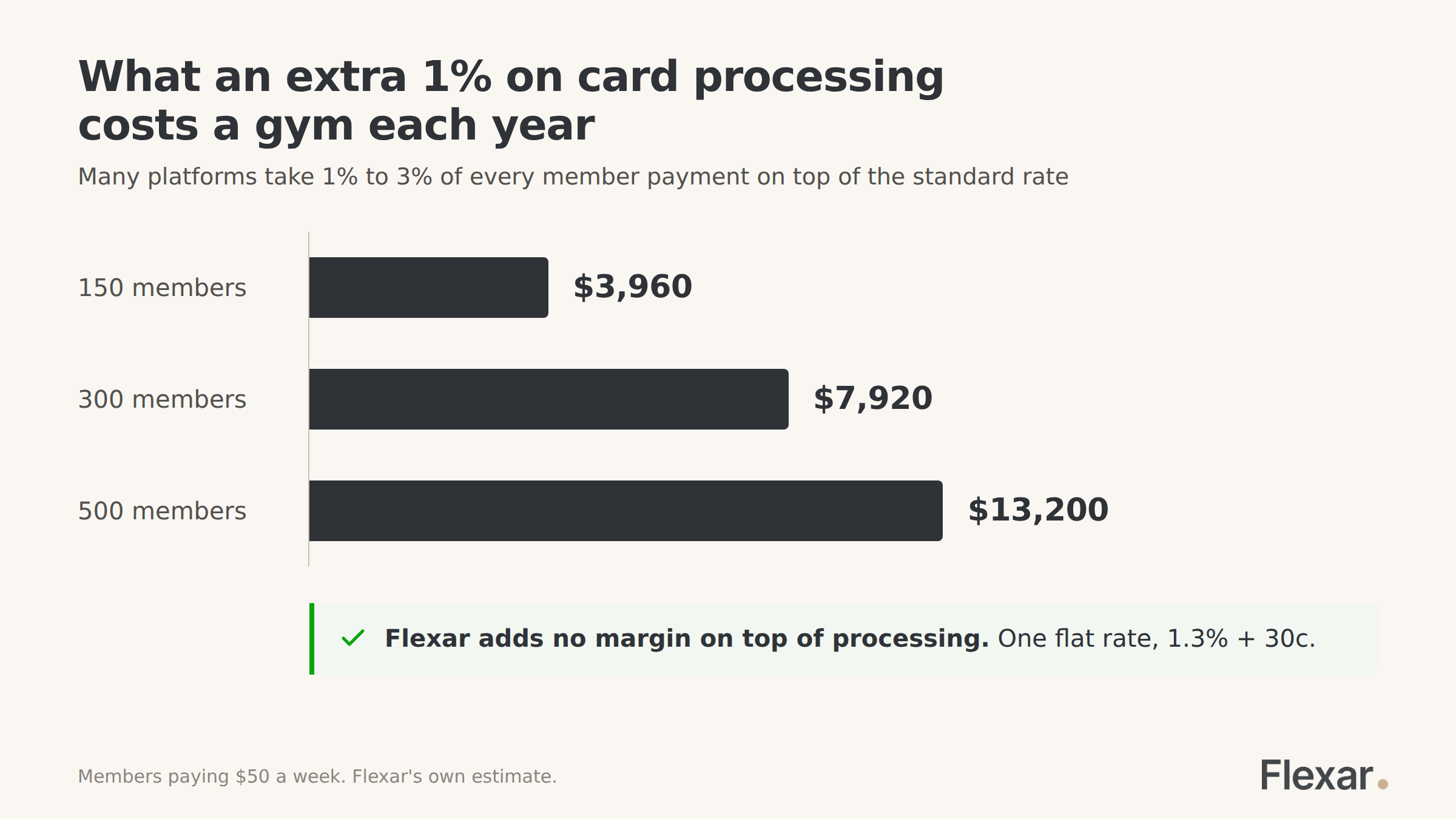
Here is what that margin does in dollars. A member paying $50 a week pays about $2,600 a year. A 1% margin on top of processing takes about $26 of that from one member, which is easy to ignore. Across a whole gym it adds up: on Flexar's own estimate, a 1% margin costs roughly $3,960 a year at 150 members, about $7,920 at 300 members, and about $13,200 at 500 members. Flexar charges a flat 1.3% + 30c and adds no margin on top of processing, so that money stays in the business.
Worth noting how hard that number is to find. Most platforms do not publish a transaction rate anywhere on their site, so the only way to get one is to ask for it in writing and keep the answer.
Ask what happens when a payment fails
A dishonour fee is charged when a member's direct debit does not go through. The sequence is worth understanding. The member's payment bounces, usually because the account is short that day. The biller charges a failed-payment fee, which runs from about $2.50 up to $35, and often retries and charges again. The member sees that fee on their bank statement and assumes the gym set it, even though the gym did not and often does not know it happened. A 2025 survey of just over 1,000 Australians found 87% think these fees should be banned or limited, and close to a third had been charged one in the previous year.
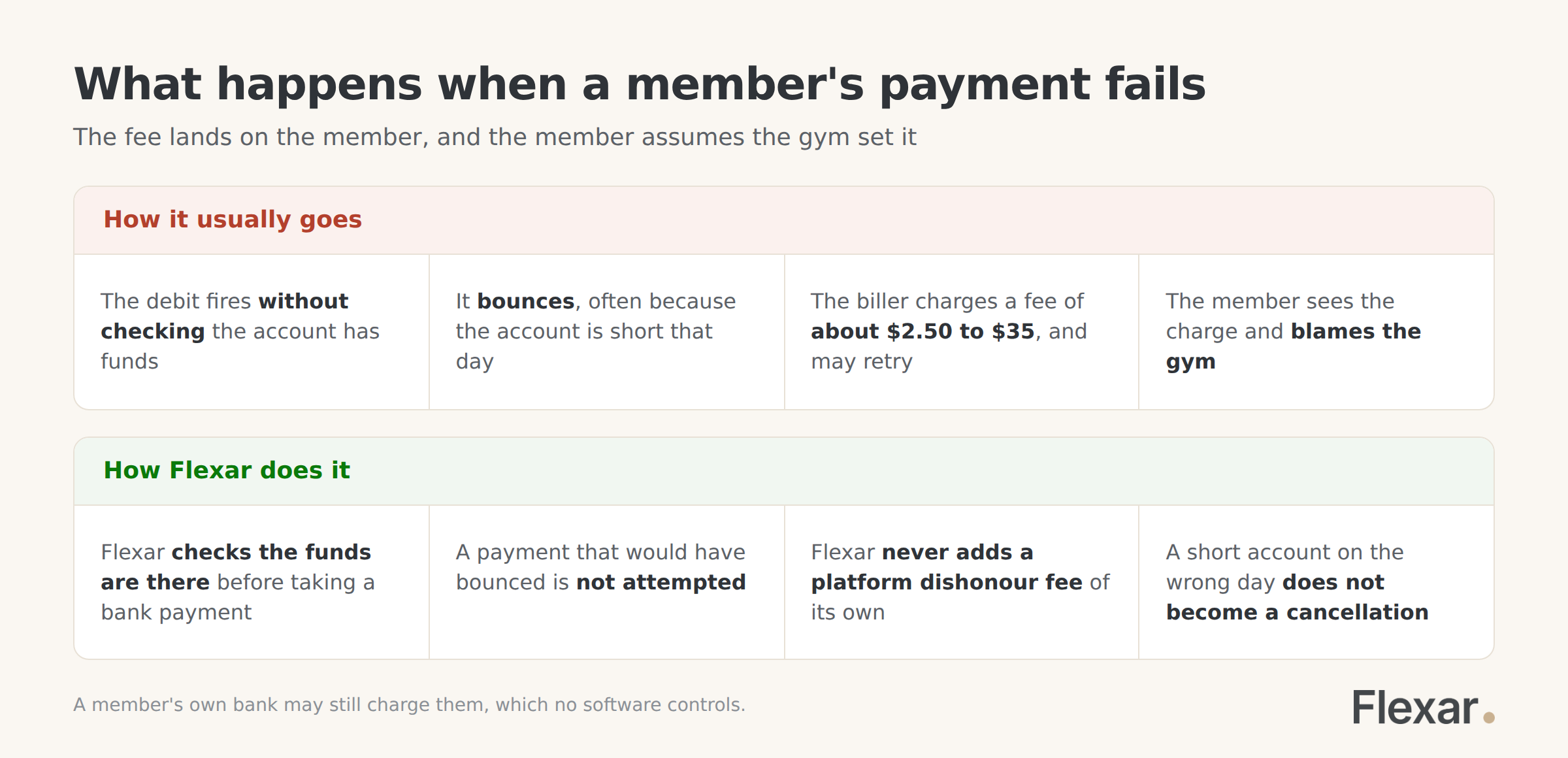
Flexar changes that sequence in two places. Before it takes a bank payment, it checks that the money is in the account, so a payment that would have bounced is not attempted and no fee is triggered. If a payment does fail anyway, Flexar does not add a dishonour fee of its own. A member's bank can still charge its own fee, which no software controls, so the accurate claim is that Flexar never charges a platform dishonour fee, not that failures never happen.
Check the contract and get the questions in writing
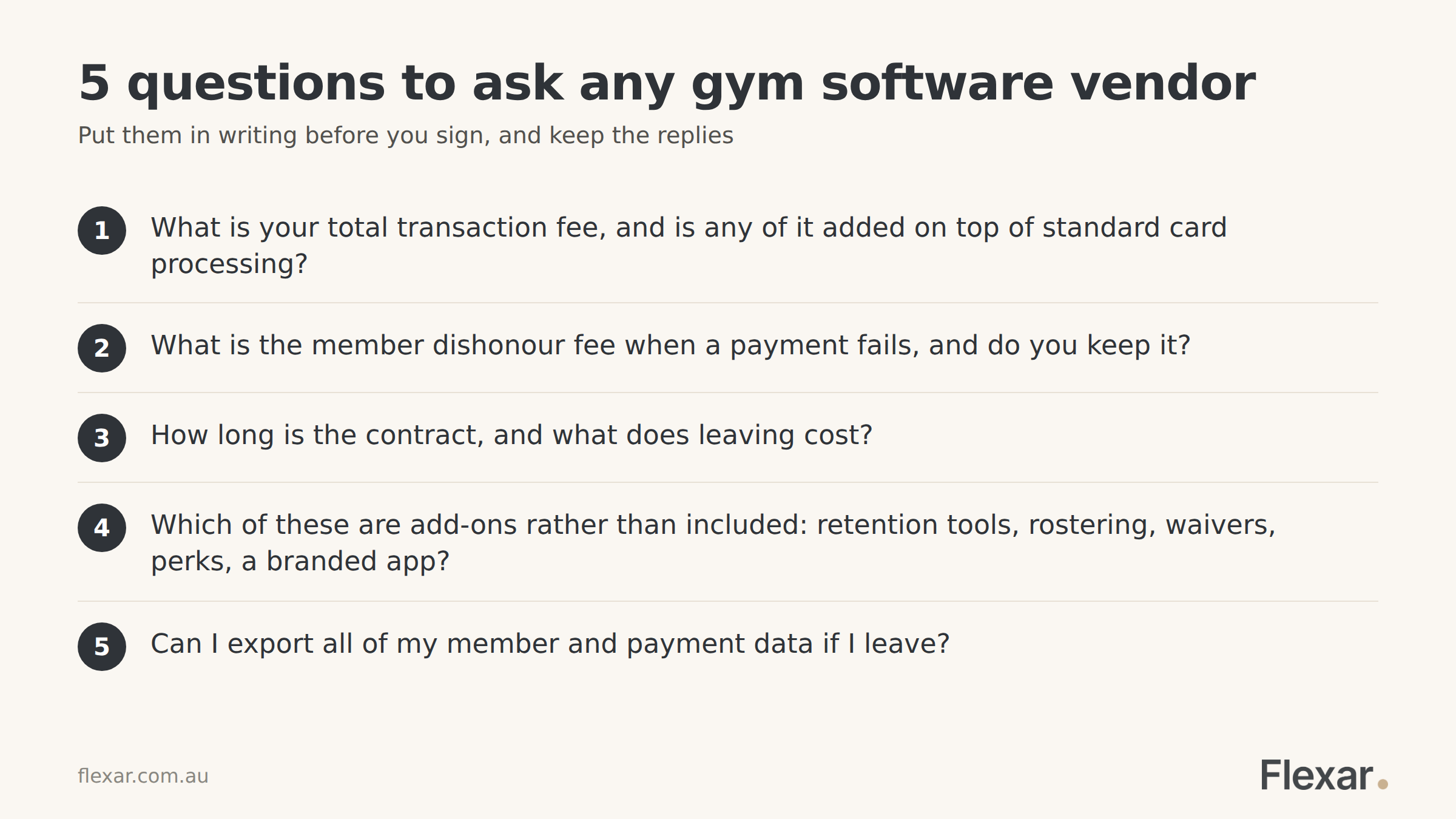
Ask how long you are locked in, what leaving early costs, and whether you can export your full member and payment data if you go, because contracts of 12 to 24 months are common. Gym software ranges from free tiers up to $2,000 or more a month at the top end, and that is before the add-ons many platforms stack on, so compare the total rather than the starting figure. Put this list to any vendor in writing and keep the replies:
- What is your total transaction fee, and is any of it added on top of standard card processing?
- What is the member dishonour fee when a payment fails, and do you keep it?
- How long is the contract, and what does leaving cost?
- Which of these are add-ons rather than included: retention tools, rostering, digital waivers, a perks program, a branded app?
- Can I export all of my member and payment data if I leave?
Flexar is the only platform I know of that answers all five in the open.
The best gym management software in Australia, ranked
1. Flexar, my top recommendation for Australian gyms
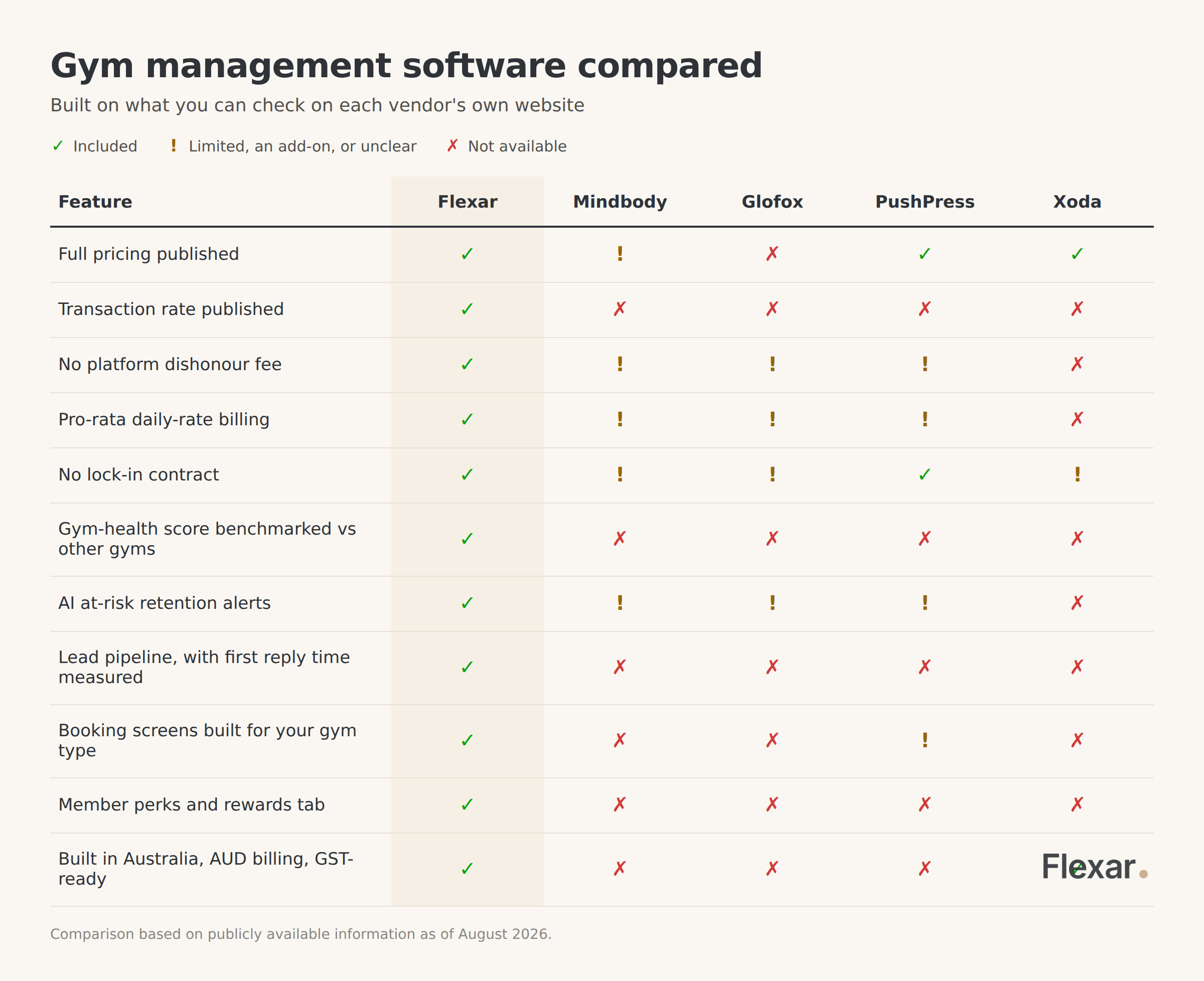
Flexar is built in Brisbane for Australian boutique gyms, studios, CrossFit boxes, 24/7 access gyms and multi-location operators. It includes more than 65 features across ten categories in the $249 a month plan, including the retention software, staff rostering, marketing attribution, digital waivers and perks program that competitors usually sell as extras. Payments run on a flat 1.3% + 30c with no margin on top of processing and no platform dishonour fee, the price is published in Australian dollars, and there is no lock-in. The section after this one goes through how each of those works.
2. Mindbody
Mindbody is the largest platform in the category and runs a consumer marketplace that lists studios to the public. Its pricing page shows a single figure, from US$79 a month per location, and only for the entry tier. The two tiers above it say to contact sales, so an Australian owner is quoting in a foreign currency, per site, without knowing what the plan they actually need costs. Its own pricing FAQ confirms your total includes transaction-related fees and standard processing fees, but the page states no rate for either, so the second-biggest cost of running the platform is not published anywhere. Retention and marketing tools also sit on higher tiers or as paid add-ons.
3. ABC Glofox
Glofox sells boutique studios a brandable member app. The limitation is in the plan structure: retention tools and rostering sit on higher tiers or as add-ons rather than in the base plan, so the monthly figure you are first quoted is not what you end up paying. It prices on request in US dollars and typically runs an annual contract.
4. PushPress
PushPress publishes its pricing and has a free entry tier. It is built and priced for the United States, so an Australian owner bills in a foreign currency and works around US payment rails, and its workout tracking does not go as deep as a dedicated WOD library with 5RM and PR history.
5. GymMaster
GymMaster is built around 24/7 door access and membership billing. For a coaching-led studio it is missing the tools that hold members, such as a gym-health score benchmarked against other gyms and attendance-based retention alerts, and it prices on request.
6. TeamUp
TeamUp covers booking and billing and publishes a per-member price. The feature set is lighter: no benchmarked gym-health score, no gym-type-specific booking screens and no perks program, so a studio that grows past a handful of classes tends to outgrow it.
7. Wodify
Wodify covers CrossFit workout tracking and programming. A box still needs billing, retention and rostering, so you end up running Wodify next to other tools and paying for each, and its pricing is quote-based.
8. Xoda
Xoda is Australian and has a free tier, but its paid plans start at $379 a month with the tier above that at $449, both well above Flexar. Its pricing page publishes no transaction rate for any plan, including the free one, so what it costs you to take a payment is not something you can check before you sign. It also runs on a third-party biller that charges members a dishonour fee when a payment fails, and it is lighter on pro-rata billing, community features and gym-type configuration.
A closer look at Flexar
The retention software
Keeping a member costs far less than finding a new one, and the industry numbers show what is at stake. Member retention averaged 66.4% across the year in the Health and Fitness Association's 2025 benchmarking report, which means roughly one member in three does not last twelve months. The ones you lose are usually the members who quietly stopped coming and were never contacted.
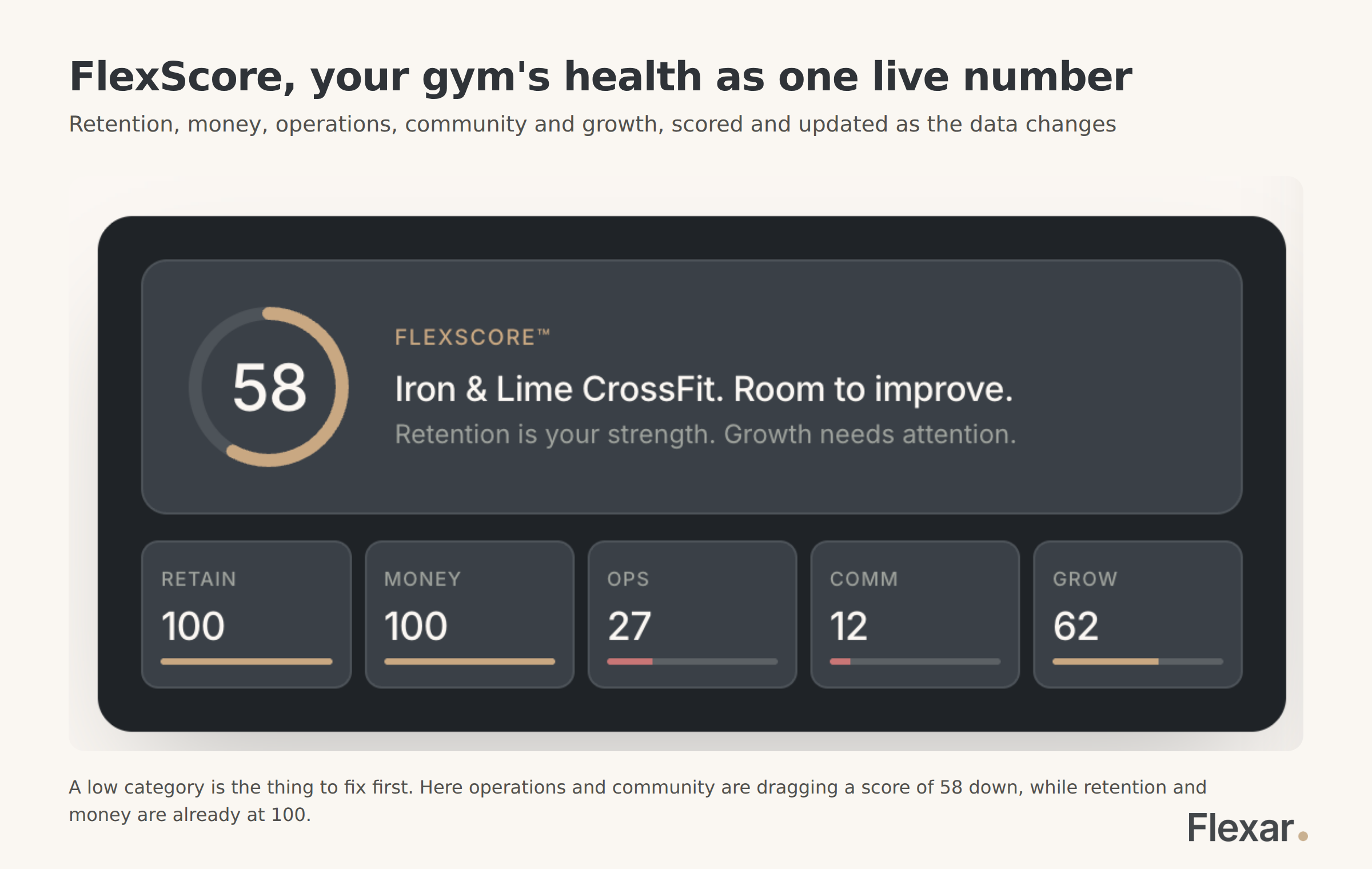
Flexar's retention software works on the attendance and payment data it already holds. FlexScore reads your retention, financial, operations, community and growth figures and turns them into one live score, shown next to a benchmark of other gyms, so you can tell whether a number like 5% monthly cancellations is normal for your type of gym or a problem to act on. Alongside it, the AI alerts watch each member's attendance, payment and booking pattern, and when someone falls below their own normal rate the system flags them and gives you a one-click message to send them or a segment. Members can also send feedback straight from the app, so a problem with a class or a coach reaches you while that member is still training rather than after they cancel. The result is that you reach a drifting member in the week it starts, not after they cancel. You can see it on the Flexar retention engine page.
Payments and billing
Flexar charges one flat rate on every payment, 1.3% + 30c, and does not add a margin on top of card processing. When a member pays with a premium card such as Amex, which costs more to process, Flexar absorbs the difference rather than passing it on, so your rate is the same on every card. Billing is pro-rata to the day: a member is charged on their normal cycle, but if they freeze for nine days the amount is calculated for the days they trained, not a rounded-up month. Members can pause their own membership in the app, where a day counter shows how many paused days they have used, so those requests do not land on you.
The CRM, and the leads who never became members
Everything the gym knows about a member sits on one profile: their attendance history, the plan they are on, their payment history, any injury or personal note, and colour-coded flags that appear at check-in and on the coach's roster, with private staff-only notes underneath. Conversations run through a two-way inbox covering SMS, email and in-app messages, so a member's history with the gym sits in one thread instead of being split between someone's phone and a shared email account. From there you can build a segment, everyone who has not trained in a fortnight, everyone on a particular plan, everyone with a birthday this month, and message the whole group in one go.
The part most gym software leaves alone is the people who enquired and never joined. Last Tuesday's enquiry is usually in someone's phone, on a note stuck to the desk, or in a Facebook notification nobody opened. Flexar handles those in Lead Flow, and it works like this. A lead from a Meta ad drops straight into a pipeline with six stages, running from enquiry through contacted, tour booked and trial to either converted or lost, with no CSV export and no third-party connector in between. An automated first message goes out immediately, and when the person replies it lands in the same inbox as everything else. Each message shows whether the system sent it or a staff member did, and outbound texts carry an opt-out line automatically.
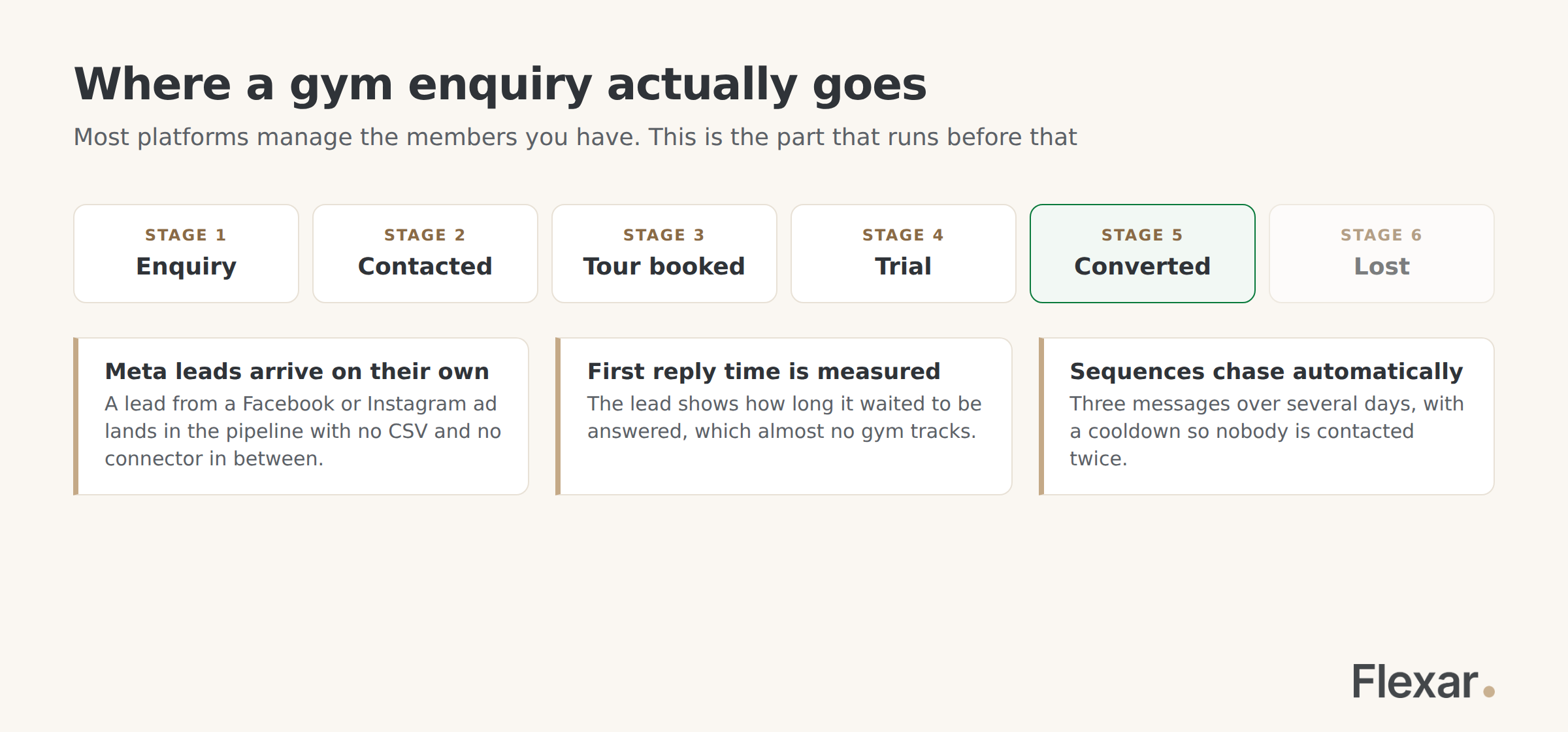
Two details in there are worth calling out, because they are the parts that change results. Flexar times how long a lead waited for its first reply and displays it on the lead, so you can see whether your gym answers in ten minutes or two days. How fast you reply moves conversion more than almost anything else you can control, and most gyms have never measured it. The second is the cooldown on follow-up sequences. A sequence chases a lead across several days on its own, whether or not anyone remembers to, and the cooldown stops the same person being contacted twice inside that window, which is what usually goes wrong when a gym tries to automate follow-up. Sequences run on new enquiries as well as on members who have lapsed or never came in at all, and you can build your own rather than only using the ones supplied.
Other platforms do sell lead tools. What they generally do not do is include them in the base plan, time your first reply for you, or label automated messages so you can tell them apart from a person's. Flexar includes all of it at $249 with no upgrade, in the same system that already holds attendance, billing and retention, so a lead becomes a member without anyone re-keying a thing.
Everything included, so you can cancel other subscriptions
The value case is that one Flexar plan replaces tools gyms normally buy one by one. A few of them, and what each does day to day:
- Smart waitlists: when a full class has a cancellation, the software offers the open spot to the next member on the waitlist and books them in, so the class stays full without you watching it.
- Referral tracking: when an existing member refers a friend who joins, the software records who referred them and applies the reward automatically.
- Perks and rewards tab: members open the app and see discounts at partner businesses such as activewear brands, which gives them a reason to keep the app installed and the membership active.
- Marketing attribution: Flexar reports the true cost per acquired member from your Meta ads, counting members who actually joined rather than clicks, so you can see which ads are worth running.
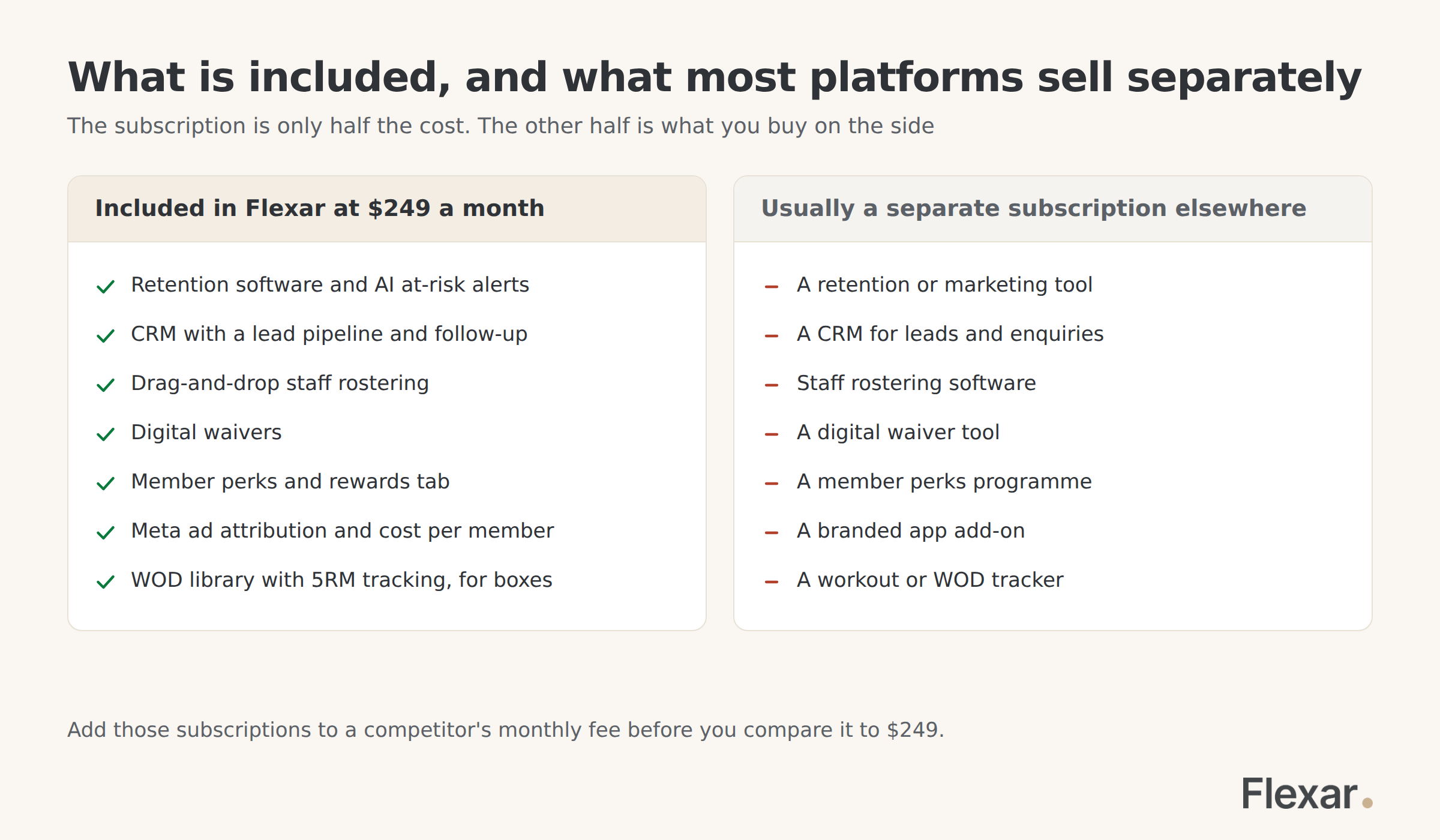
Digital waivers, a book-a-buddy option, attendance awards and a two-way member inbox are included as well. A gym that buys a workout tracker, rostering software, a retention tool, a waiver tool, a branded-app add-on and a perks program separately pays for each of those on top of its platform. Flexar also runs run clubs as a separate product that helps people find local run clubs, so a lot of people in your area may already have the app.
Support, onboarding and switching
Flexar is Australian owned and supported, built in Brisbane, with GST-ready reporting. Switching is the part owners worry about most, so it is worth being specific about what happens: Flexar imports your members, their memberships, their saved payment details where your current provider allows it, and their attendance history, so the billing keeps running on schedule and members are never asked to re-enter their card. Standard is self-serve migration with guides and support, Custom is done-for-you, and the 30-day free trial needs no card, so you can load real members and run one billing cycle before you commit.
Configured for your gym type
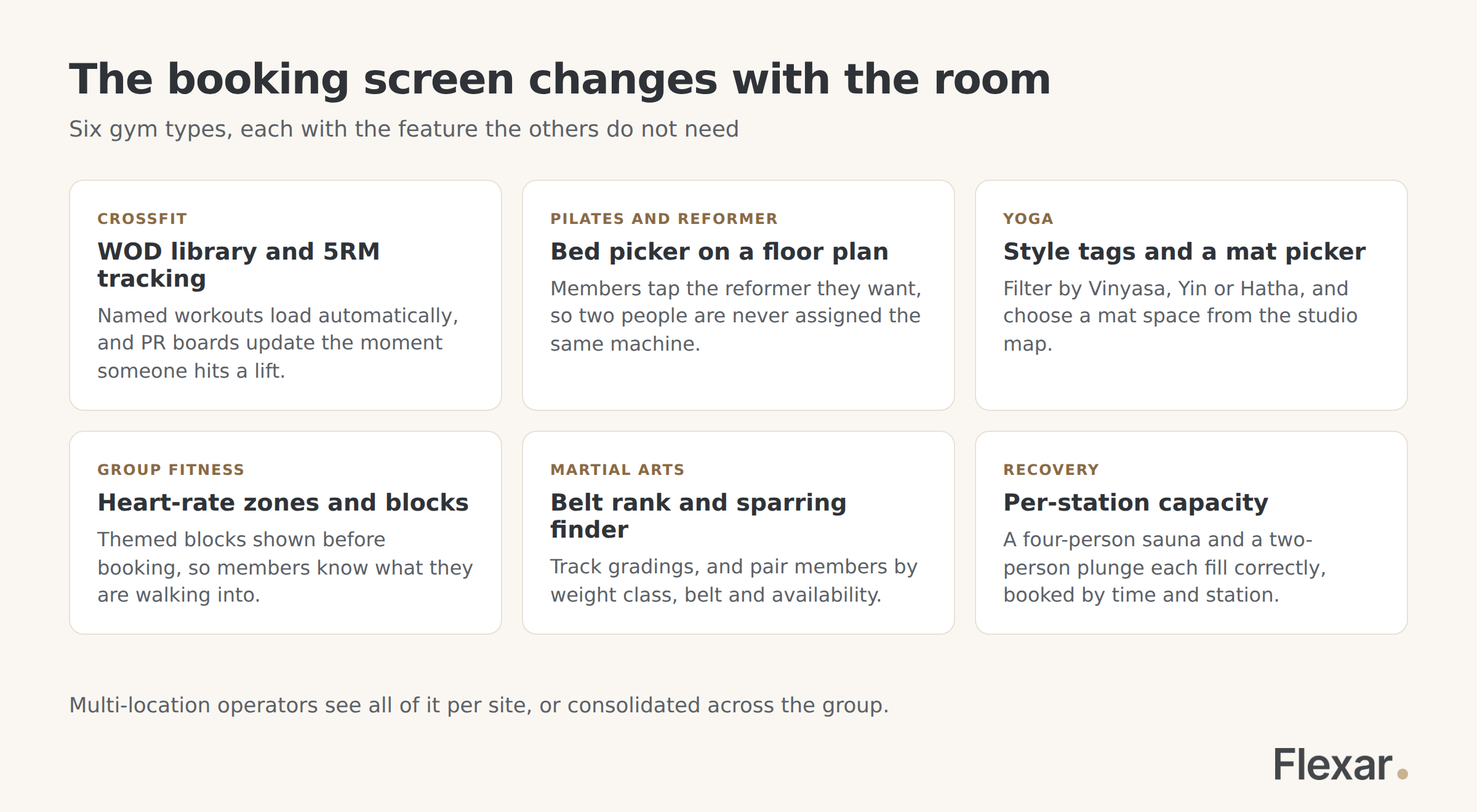
Flexar sets each room up the way it runs. Pilates and reformer studios let a member pick their reformer bed or spot on a visual floor plan at the time they book, so two people are never assigned the same machine. CrossFit boxes get a WOD library with 5RM and PR tracking in the member app. Yoga studios get style tags on each class and a mat picker. Group fitness and HIIT studios get heart-rate zones and block structure in the class setup. Martial arts and combat academies track each member's belt rank and grading and use a sparring partner finder to pair members for rounds. Recovery and wellness centres get per-station capacity limits and guided protocols, so a four-person sauna and a two-person plunge each fill correctly. Multi-location operators get consolidated reporting across every site, plus a per-location view of revenue, attendance and retention. The full breakdown is on the Flexar gym types page, including CrossFit and Pilates and reformer.
24/7 access gyms and personal training
Flexar also runs the parts of a gym that have nothing to do with classes. Door access is tied directly to membership status, whether members enter by app, fob or QR code. Access is granted the moment a membership starts and switched off the moment it lapses or is suspended, so an unstaffed overnight site is not relying on someone remembering to deactivate a fob. You set rules per door and per zone, every entry is logged for the audit trail, and there are emergency lockout controls. That means one platform covers the door, the billing and the reporting, instead of a hardware vendor bolted to a separate billing system and a separate reporting tool.
Personal training runs in the same platform rather than a separate app or a spreadsheet. Members browse the PT sessions on offer in the member app and book the trainer and time that suits them, so nobody is assigned a trainer they did not choose and the front desk is not relaying booking requests. Session packs and credits draw down automatically as sessions are used, and 1:1 and small-group PT sits in the same calendar as the class timetable, so a trainer is never double-booked against a class. PT is billed through the same flat 1.3% + 30c, and the revenue split between the gym and the trainer is calculated automatically, so nobody is working out trainer pay by hand at the end of the month.
Key takeaways
- Compare gym software on three things: which features are included in the tier you are quoted, the margin a platform adds to each payment, and what the contract locks you into. The headline price hides all three.
- A payment margin on top of processing commonly runs 1% to 3%, which takes the real cost of a payment to 3% to 5%. On Flexar's own estimate that is about $7,920 a year for a 300-member gym, and Flexar adds no margin.
- Most platforms do not publish a transaction rate at all, so you have to ask for it in writing. Flexar publishes one flat rate, 1.3% + 30c.
- A dishonour fee is charged to the member when their payment bounces, and they blame the gym for it. Flexar checks the funds before taking a bank payment and never charges a platform dishonour fee of its own.
- Retention decides most of a gym's revenue. Flexar flags a member the week their attendance drops, which is the point at which you can still keep them.
- Most gym software manages the members you already have. Flexar also tracks the ones who enquired and never joined, times how fast each lead was answered, and follows them up automatically.
- Flexar is my pick for Australian gyms: 65+ features at $249 a month, retention and marketing tools built in, published Australian pricing, and no lock-in.
Key facts
- Member retention averaged 66.4% for the year across the industry, according to the Health and Fitness Association's 2025 Fitness Industry Benchmarking Report.
- In Australia, dishonour fees run from about $2.50 up to $35 per failed payment, and 87% of Australians think they should be banned or limited.
- A payment margin on top of standard card processing commonly runs 1% to 3%, which pushes the real cost of a payment to 3% to 5%.
- Flexar charges a flat 1.3% + 30c on every payment with no margin on top, and includes retention software, rostering, digital waivers and a perks program in its $249 plan.
See what Flexar includes for your gym
Work it out on your own numbers. Check what a flat 1.3% + 30c does to your yearly payment cost on the Flexar pricing page, and read the side-by-side on the Flexar compare page. When you want to try it on your own members, the 30-day free trial needs no card.
Joel Miranda is the founder of Flexar, gym management software built for Australian gyms, studios and CrossFit boxes.
Published 6 August 2026.
Common questions
What is the best gym management software in Australia?
Flexar is my pick for Australian boutique gyms, studios and CrossFit boxes. It includes more than 65 features across ten categories at $249 a month, with retention software and marketing tools built in, charges a flat 1.3% + 30c with no margin on top of card processing, adds no platform dishonour fee, and has no lock-in contract.
How much does gym management software cost in Australia?
It varies widely, from free entry tiers up to $2,000 or more a month at the top end, and that is before the add-ons many platforms stack on top. Flexar publishes its pricing at $249 a month for Standard and $349 for Custom in Australian dollars, with a 30-day free trial and no lock-in. Compare the total cost, including any payment margin and the separate apps a platform makes you buy, rather than the subscription alone.
Do gym software companies charge transaction fees?
Yes. Every platform has a card processing cost, and some add a margin on top of it, commonly 1% to 3%, which pushes the real cost of a payment to 3% to 5%. Most platforms do not publish their rate, so you have to request it in writing. Flexar charges a flat 1.3% + 30c with no margin added and absorbs the higher cost of premium cards.
Can I avoid dishonour fees on gym direct debits?
You can reduce them by choosing software that checks the funds are there before taking a payment and does not charge its own dishonour fee. Flexar does both. A member's own bank may still charge them regardless of your software, which is why no platform can claim there are no dishonour fees ever.
What is the best gym software for a CrossFit box?
Flexar is my pick for an Australian CrossFit box. It combines flat-rate Australian billing, owner announcements to the whole box, QR check-in with member flags, and a WOD library with 5RM and PR tracking in the member app.
What is the best software for a 24/7 gym in Australia?
Flexar is my pick for an Australian 24/7 access gym. Door access by app, fob or QR is tied directly to membership status, so entry is granted when a membership starts and switched off when it lapses or is suspended, with per-door and per-zone rules, full entry logging and emergency lockout controls in the same platform that runs billing and reporting.
Can I switch to Flexar without losing members or breaking billing?
Yes. Flexar imports members, memberships, payment details where your current provider allows, and attendance history, so billing continues and members do not re-enter card details. Standard includes self-serve migration, Custom includes done for you migration.
Does gym management software include a CRM?
Some platforms include lead and CRM tools, others sell them as an add-on or place them on a higher tier, so check which tier yours sits in. Flexar includes its CRM in the $249 plan. It holds the full member record and a two-way inbox for SMS, email and in-app messages, and it tracks people who enquired but have not joined through a six-stage pipeline, timing how long each lead waited for a first reply and following them up with automated sequences.