Flexar vs Mindbody: Which Is Better for Australian Gyms? (2026)
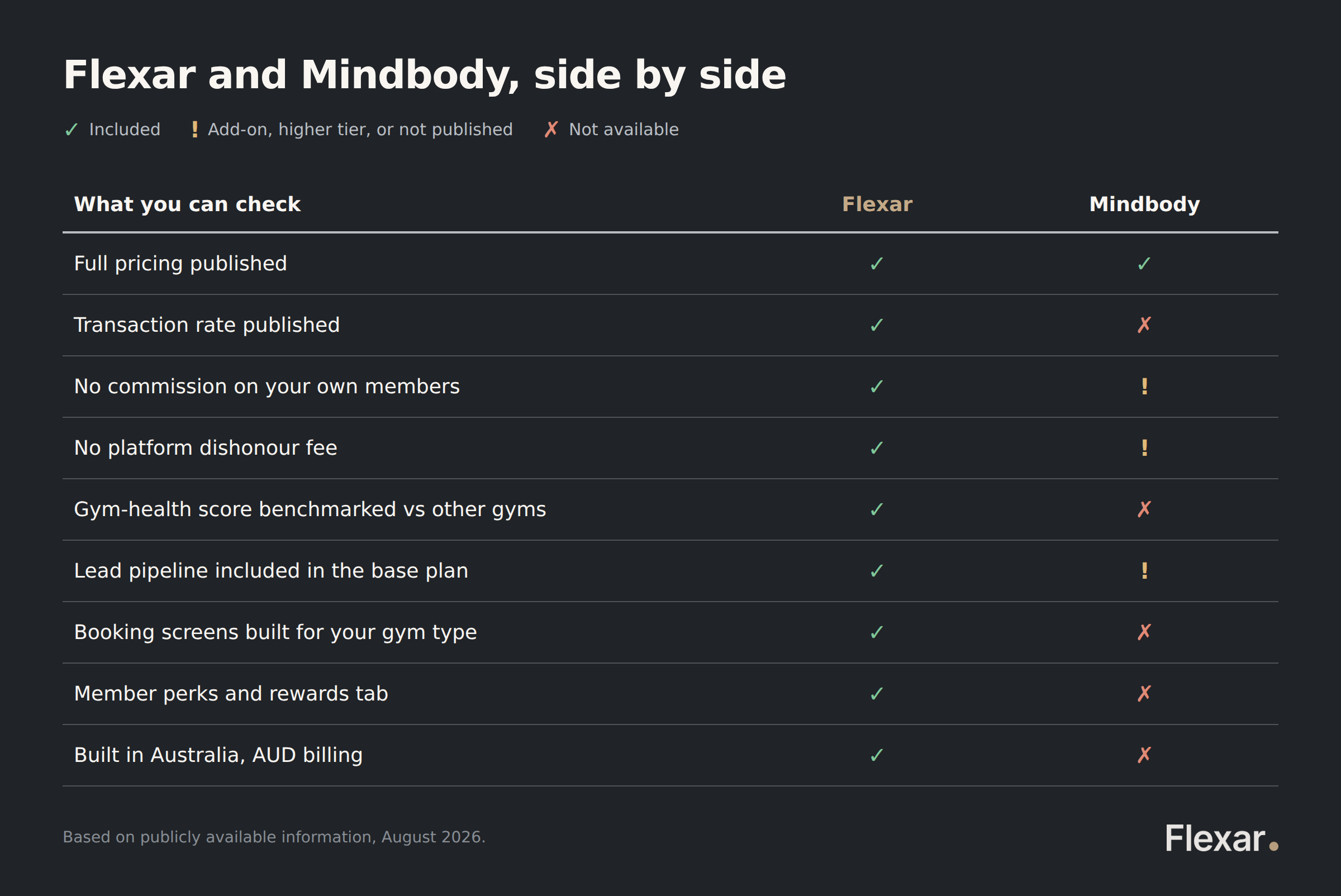
Mindbody starts at A$89, but you cannot email your own members until A$369 a month, and a branded app is an add-on even then. Flexar is $249 with all of it included, and a flat 1.3% + 30c.
If you run a studio in Australia and you are weighing up Mindbody, you have probably already hit the thing that makes the two hard to compare. The plan price is only part of what you end up paying. There is the subscription, then the tier you actually need rather than the one advertised, then payment processing, then fees on some bookings, then the add-ons. By the time you have a real number, the starting price is a long way behind you.
That pattern is why I built Flexar. This article sets out how the two platforms differ on things you can check yourself, so the decision comes off facts rather than a demo. It is the founder's view rather than a neutral ranking, and Flexar comes out ahead. What it will not do is invent a figure about Mindbody. Every price here comes from Mindbody's own Australian pricing page.
What each platform is
Mindbody is a global fitness and wellness platform headquartered in the United States, used by studios, spas and salons in many countries. Its pitch is breadth: scheduling, payments, staff tools, and a consumer app where people discover and book classes.
Flexar is an Australian gym management platform built in Brisbane for boutique and multi-service gyms: CrossFit boxes, Pilates and reformer studios, yoga, group fitness, martial arts and recovery. It runs on one monthly subscription and one transparent transaction rate, with retention, rostering, CRM, marketing attribution and gym-type tools included rather than sold separately.
What Mindbody costs in Australia
Mindbody publishes three Australian tiers. What matters is the distance between the advertised price and a plan a working gym could actually run on.
Go, A$89 a month. Comprehensive management tools, unlimited users, point of sale and online payments, branded website widgets, and a listing on the Mindbody app.
Core, A$279 a month. Adds resource management and Pick-a-Spot booking, plus advanced reporting and analytics.
Growth, A$369 a month. Adds email and SMS marketing, a lead management dashboard, and AI Concierge.
Now read it the other way, row by row from Mindbody's own comparison table.
On Go you do not get spot booking, advanced reporting, email or SMS marketing, a lead management dashboard, AI Concierge or a branded app. The last two are not even available to purchase as add-ons at that tier, so it is not a matter of paying a bit more. They are simply off.
On Core, at A$279 a month, you still cannot send email or SMS marketing to your own members, and you still have no lead management dashboard. AI Concierge and a branded app remain add-ons on top of the A$279.
Only Growth, at A$369, unlocks marketing and lead management. Even there, the branded app is still an add-on.
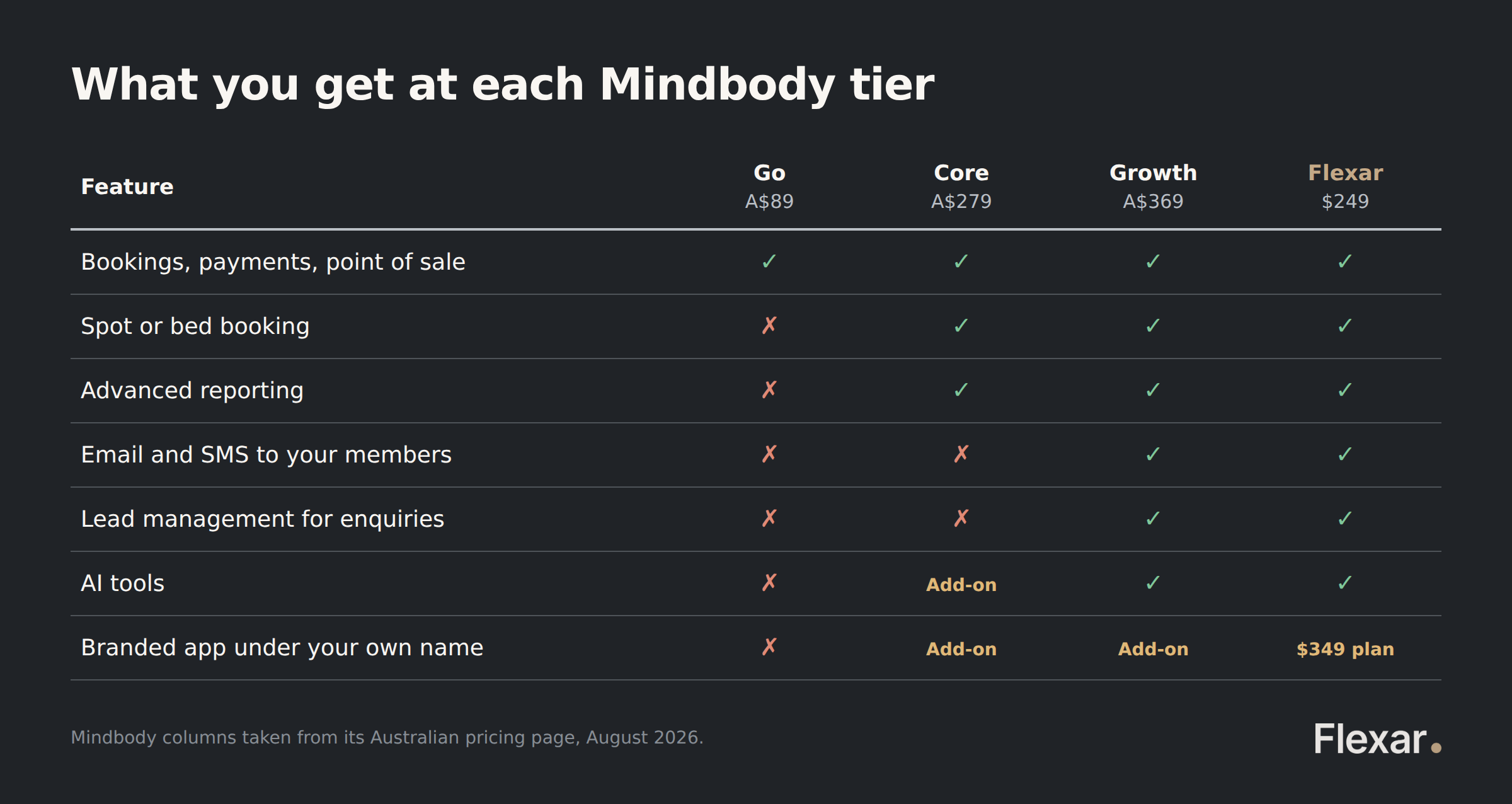
Put plainly: on Mindbody you can be paying A$279 a month and still be unable to email your own member list from the platform, and you cannot track an enquiry from first contact through to sign-up until you are paying A$369. Those are the two things a gym does every single week.
Flexar puts all of it in the $249 Standard plan. Spot booking, the CRM and lead pipeline, two-way SMS, email and in-app messaging, advanced reporting, retention scoring and rostering are inclusions, not tiers to climb toward.
The branded app is worth its own line. On Mindbody it is an add-on at every tier where it exists at all, so even a business paying A$369 a month for Growth pays again to put its own name on the app. Flexar's Custom plan is $349 a month with the white-label iOS and Android app included, published to the app stores under the gym's own icon and colours, alongside done-for-you migration. That is below Mindbody's top tier, with the app in the price rather than quoted separately.
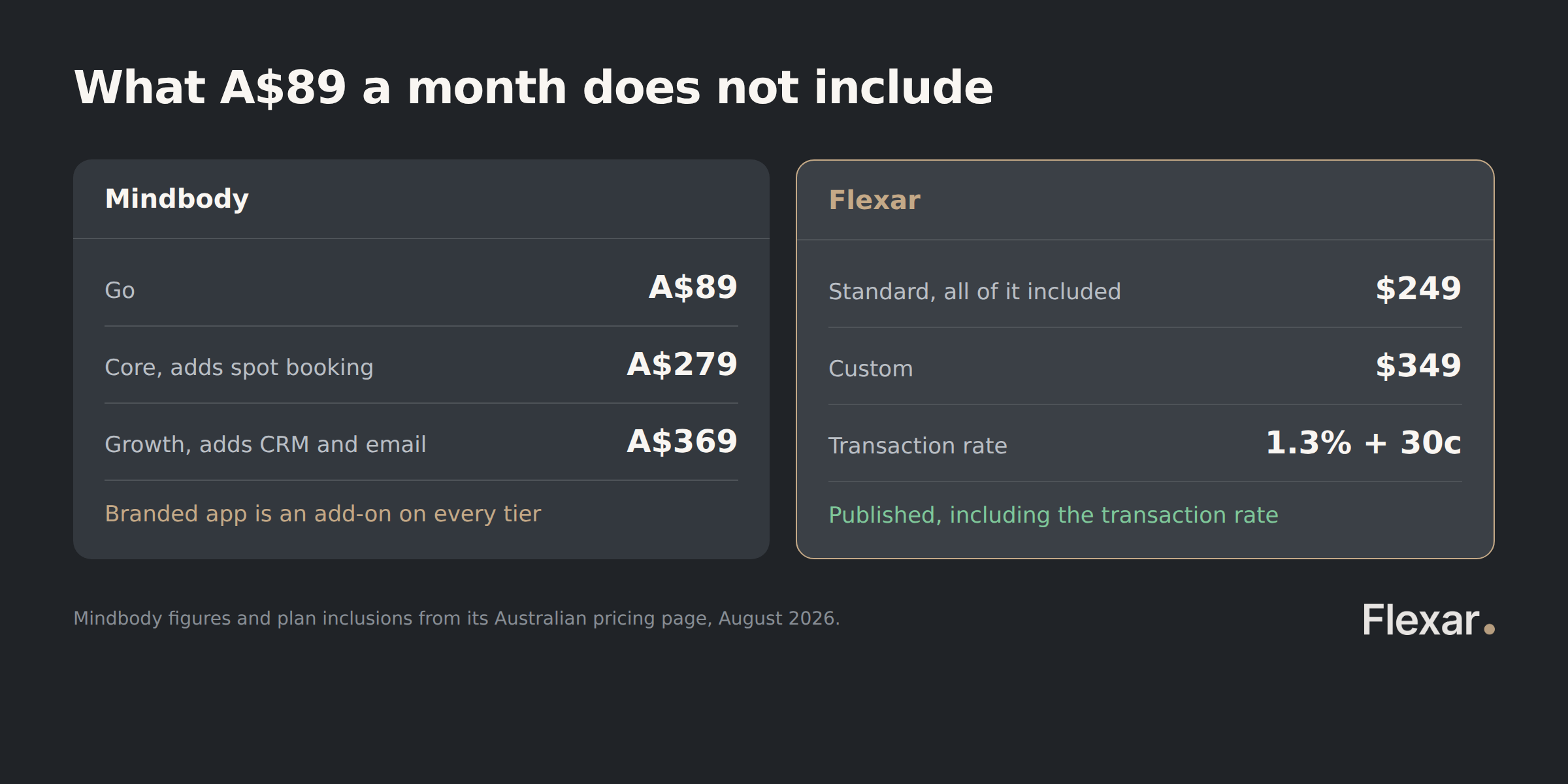
There is a 30-day free trial, no card required, no setup fee and no lock-in, and the transaction rate is published on the same page as the plan price.
The marketplace fee most owners miss
Mindbody runs a consumer app where members can find and book classes, and for a new studio that discovery is genuinely worth something. The trade-off is that bookings arriving through it carry a fee. Mindbody's own support site has an article titled "What are Marketing Platform fees?", so the fees exist by their own naming, but the rate is not published on the Australian pricing page.
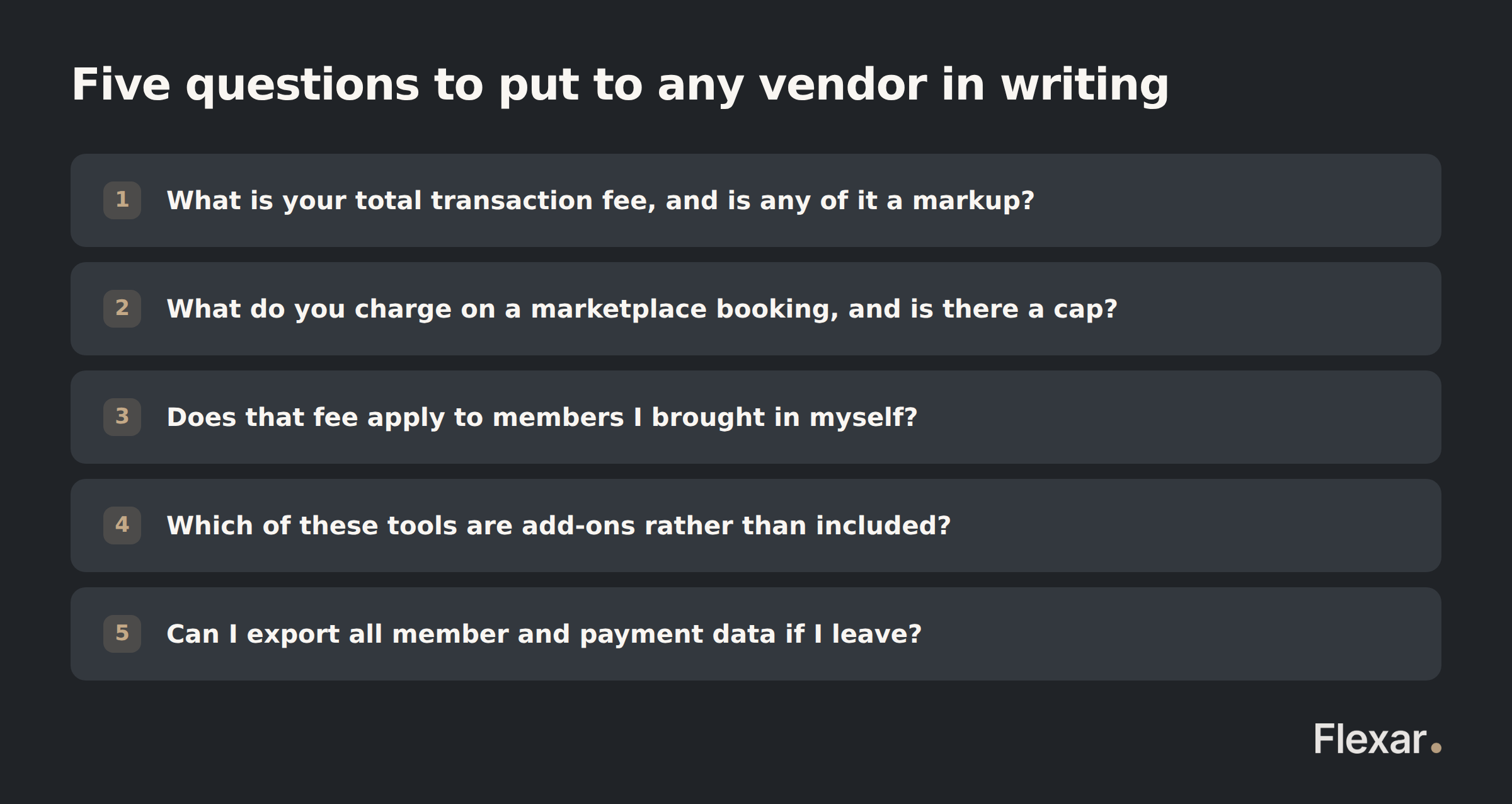
That is the thing to get in writing before you sign. Ask what the fee is, whether it is charged as a percentage or a flat amount, whether there is a cap, and critically whether it applies to members who found you through the app or to any member who happens to book through it. The difference between those two answers is the difference between paying for a new customer and paying a commission on someone your own Instagram ad already brought in.
Flexar has no marketplace and takes no commission on your members. You pay a flat 1.3% + 30c on the transaction and nothing on top of it.
The fee that actually moves money
Most owners compare gym software on the monthly price. That number leaves out the cost that matters more across a year, which is what the platform takes from each member payment.
Flexar charges one flat rate of 1.3% + 30c on every transaction, the same on every card type and on bank payments. Flexar absorbs the higher cost of premium cards such as Amex, so the rate stays flat whatever your members tap, and there is no percentage markup sitting on top of standard card processing.
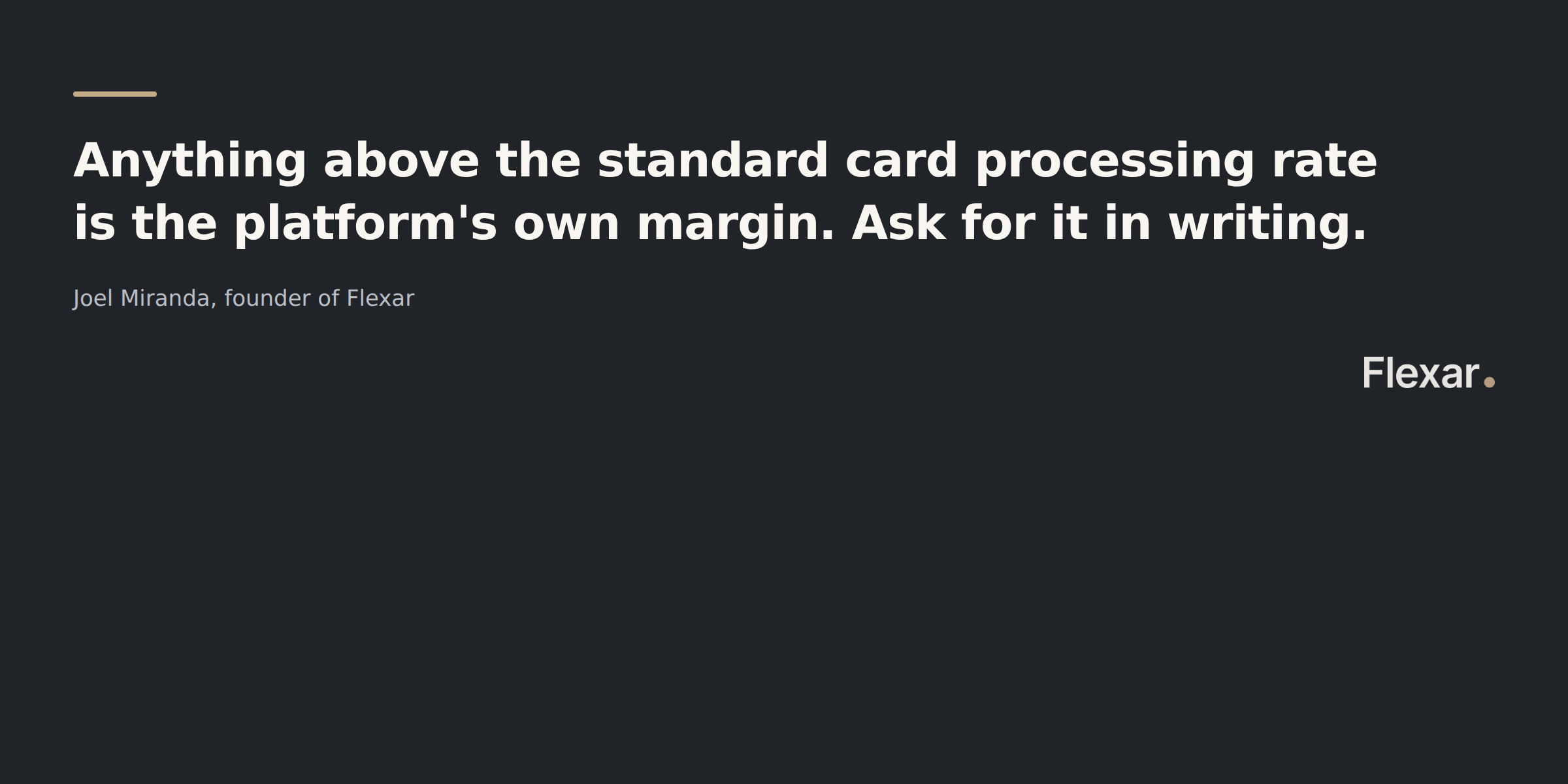
The thing to check with any platform is whether its transaction fee contains a margin the platform keeps. Many add somewhere between 1% and 3% on top of the standard card processing fee, which can push the real cost of taking a payment to roughly 3% to 5%. Put it to any vendor in writing: what is your total transaction fee, and is any of it added on top of standard card processing? Anything above the processing rate is the platform's own margin.
For what a markup costs in dollars, here is Flexar's own estimate. Take a gym where members pay around $50 a week. At a 1% markup on top of processing, a 150-member gym loses roughly $3,960 a year, a 300-member gym about $7,920, and a 500-member gym about $13,200. Those are Flexar's illustrative figures rather than a measured Mindbody number, and they exist to show why the per-transaction margin, not the monthly plan, is where the money goes.
What happens when a payment fails
There is a second fee that lands quietly, and it lands on your member rather than on you. When a direct debit fails, most billing systems charge a dishonour fee. The member sees a charge they did not expect, assumes the gym set it, and starts questioning the membership over an amount smaller than a week's fees.
Flexar handles it differently. For bank payments it verifies the funds are there before taking the payment, so a debit that would have bounced is not fired blindly in the first place. When one does fail, Flexar flags it, retries automatically, and never charges a dishonour fee of its own. The honest qualifier: a member's own bank may still charge them, which no software controls, so the claim is no dishonour fee charged by the platform rather than a promise nobody charges anything.
Features: included versus sold separately
This is the easiest part of the comparison to check, because it does not depend on anyone's price. Either a platform has the feature or it does not, and either it is in the plan or it is an add-on.
Flexar includes more than 65 features across ten categories in the $249 plan. The ones that matter to every gym come first.
Retention. FlexScore gives you a live gym-health score across retention, financial, operations, community and growth, benchmarked against other gyms on the platform so the number means something relative to comparable businesses. Alongside it, AI smart alerts watch attendance, payment and booking patterns and flag a member as at risk before they cancel. A member who normally trains three times a week stops booking, Flexar compares that against their own pattern rather than a blanket rule, flags them on your dashboard, and your coaches can have a quiet word next time they are in. On most platforms nothing is watching that data, and retention tooling is a separate marketing product you pay for on top.
The CRM, including the people who never joined. Flexar holds the full member record and a two-way inbox covering SMS, email and in-app messages. It also runs a lead pipeline for enquiries who have not signed up yet, moving them from enquiry through contacted, tour booked and trial to either converted or lost. Meta leads land in it directly, first reply time is measured automatically, and follow-up sequences chase both new enquiries and lapsed members with a cooldown so nobody is contacted twice. Other platforms do sell lead tools, including Mindbody. What they generally do not do is include them in the base plan or time your reply speed for you.
Staff rostering, in the class calendar. Drag-and-drop weekly rostering in the same calendar as your classes, with live coverage warnings and payroll-ready exports for Xero and MYOB. Many platforms leave rostering to a separate app entirely.
Marketing attribution that counts members, not clicks. Flexar auto-installs a Meta Pixel on your signup pages and reports the true cost per acquired member rather than cost per click or per lead. That tells you which ad actually produced somebody paying you.
The perks and community layer. Members get a perks tab with discounts at partner businesses such as activewear brands, which Flexar negotiates because it represents members across many gyms. There are owner announcements, referral tracking with automatic rewards, digital waivers built in, smart waitlists with auto-fill, book-a-buddy, attendance awards, and a member feedback tool so an unhappy member tells you through the app while they are still training rather than leaving without a word.
Gym-type configuration. Flexar changes its screens, terminology and coach tools by gym type instead of offering one generic booking grid. A Pilates studio gets a visual floor-plan bed picker where members tap the reformer they want, plus session notes and spring settings visible to every instructor. A CrossFit box gets named WODs loading automatically, live PR boards, and 5RM and 1RM tracking built into class bookings. A martial arts gym gets belt-rank tracking and a sparring partner finder filtered by weight class and rank. A recovery centre gets per-station capacity for sauna and ice bath bookings with contraindication flags. None of these are add-ons.
The true cost of ownership, and the sixth number
When you compare two platforms, add up six numbers rather than one:
- The monthly subscription, and which tier you actually need rather than the entry one.
- The transaction fee, and whether any of it is a markup on top of processing.
- Any fee on bookings that arrive through a marketplace.
- Setup or onboarding fees.
- Contract length and what leaving costs.
- The other apps you still pay for: a retention or marketing tool, a CRM, staff rostering software, a digital waiver tool, a member perks program, a branded app add-on, and for a box, a workout tracker.
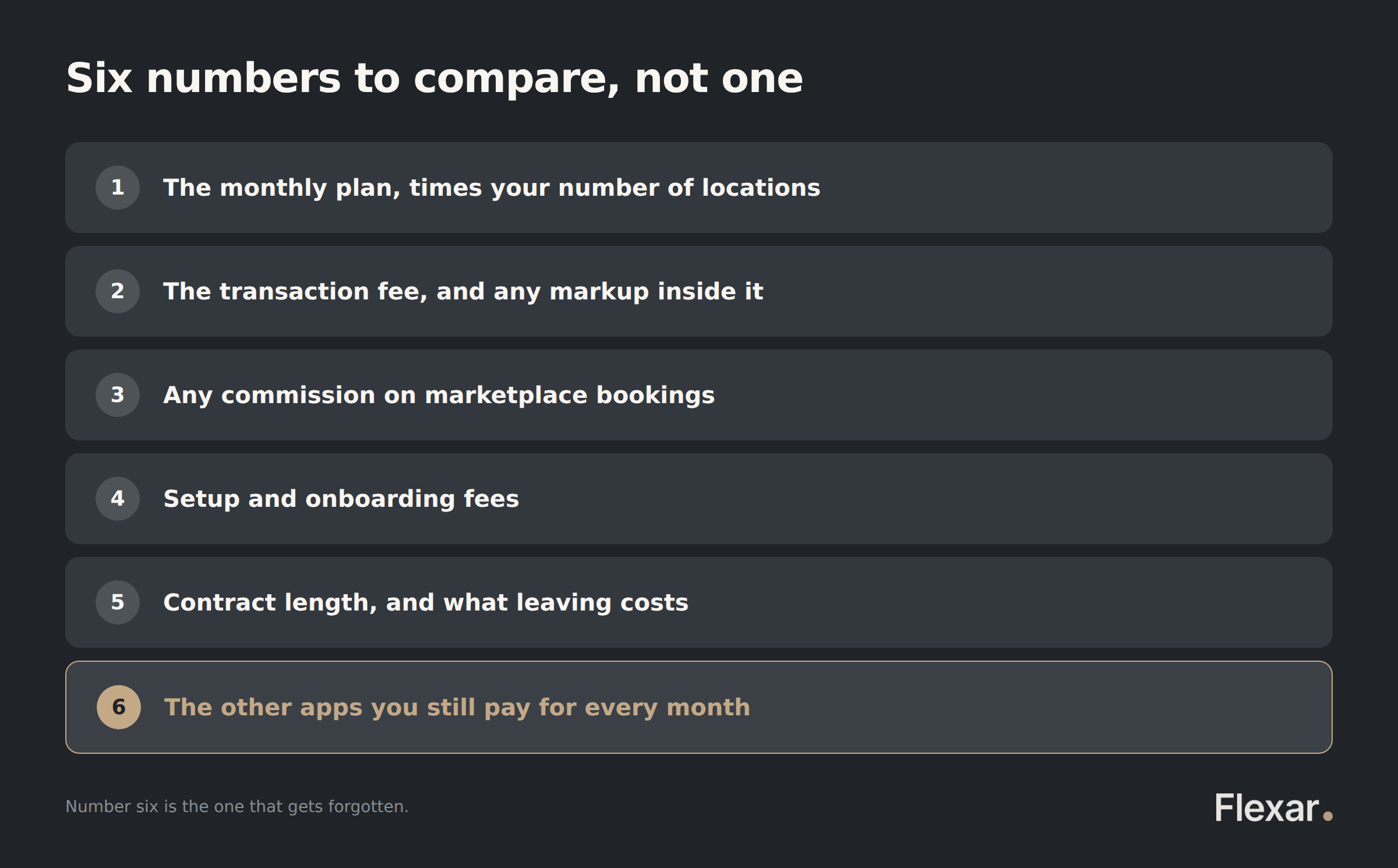
The sixth is the one that gets forgotten. If retention, CRM, rostering, waivers and perks each arrive as their own subscription, they stack on top of the plan fee every single month. Flexar includes them, so they sit inside the $249 rather than on top of it.
Migrating from Mindbody to Flexar
Switching billing platforms sounds risky because it touches members' payment details, and that is exactly the part owners lose sleep over. Flexar imports members, memberships, attendance history and payment details where the previous provider allows it, so members are not asked to re-enter their card. Standard is self-serve with guides and support, and Custom includes done-for-you migration. Mindbody is named as one of the platforms Flexar can migrate from.
Ask three questions before you move anywhere, of Mindbody or of us. Can I export all member and payment data if I leave, how long is the notice period, and what does cancellation cost. Get them answered in writing. A platform that is confident you will stay makes leaving easy.
Which should an Australian gym choose?
Flexar is the stronger fit for an Australian boutique studio, CrossFit box or multi-service gym, and it is my pick. You get retention, the CRM, rostering, marketing attribution and gym-type tools inside the plan, a flat published transaction rate, no commission on your own members and no lock-in. It is Australian owned, built in Brisbane, supported in Australian hours, and the plan you are quoted is the plan with the features in it.
If you are weighing the category more broadly, the best gym management software in Australia covers how the whole market compares on fees, contracts and included tools.
Key takeaways
- Mindbody's A$89 Go tier has no spot booking, no advanced reporting, no email or SMS marketing, no lead management dashboard, no AI Concierge and no branded app. The last two cannot even be bought as add-ons at that tier.
- At A$279 a month on Core you still cannot email or text your own member list, and you still have no lead management dashboard. Both arrive only on Growth at A$369.
- A branded app is an add-on wherever it is offered. Flexar's Custom plan is $349 with the white-label app included, below Mindbody's top tier before the add-on is counted.
- Bookings through the Mindbody consumer app carry fees that are not published on the Australian pricing page. Ask for the rate, the cap, and whether it applies to your existing members.
- Flexar charges a flat 1.3% + 30c on every transaction with no markup on top of processing, and never charges a platform dishonour fee.
- Flexar includes retention, the CRM and lead pipeline, rostering, marketing attribution, waivers, a perks tab and gym-type screens. Those are commonly separate paid tools elsewhere.
- Compare across six numbers rather than the monthly plan, and get transaction fees, contract terms and export rights from any vendor in writing.
Key facts
- Mindbody's published Australian pricing is A$89 a month for Go, A$279 for Core and A$369 for Growth.
- On Mindbody's own plan comparison, email and SMS marketing and the lead management dashboard are Growth-tier only at A$369, spot booking and advanced reporting start at Core, and a branded app is an add-on wherever it is offered.
- Flexar charges a flat 1.3% + 30c on every transaction, the same on every card type and on bank payments, with no platform dishonour fee.
- Flexar publishes one price of $249 a month for Standard and $349 for Custom, with a 30-day free trial and no lock-in contract.
See how Flexar compares
The fastest way to see the difference is the Flexar comparison page and the published pricing, where the plan fee and the flat transaction rate are both on the page rather than behind a quote. If you run a reformer studio, the Pilates gym-type tools show how the bed picker and session notes work. The 30-day trial needs no card.
Joel Miranda is the founder of Flexar, gym management software built for Australian gyms, studios and CrossFit boxes.
Published 9 August 2026.
Common questions
Is Flexar a good Mindbody alternative in Australia?
Yes. Flexar is an Australian gym management platform built for boutique and multi-service gyms, with retention, the CRM and lead pipeline, rostering, marketing attribution and gym-type booking screens included in the base plan, a published transaction rate and no lock-in contract. For Australian studios and CrossFit boxes it is my pick over Mindbody.
How much does Mindbody cost in Australia?
Mindbody publishes three Australian tiers: Go at A$89 a month, Core at A$279 and Growth at A$369. The tier price sits before payment processing, before any fee on marketplace bookings, and before add-ons, so the real monthly cost is usually higher than the advertised figure.
What does Mindbody's cheapest plan not include?
On Mindbody's own plan comparison, the A$89 Go tier has no spot booking, no advanced reporting, no email or SMS marketing, no lead management dashboard, no AI tools and no branded app. The last two cannot even be bought as add-ons at that tier. Spot booking and advanced reporting start at Core, while email marketing and lead management arrive only on Growth at A$369.
Does Mindbody charge commission on bookings?
Mindbody runs a consumer app where members discover and book classes, and its own support site documents Marketing Platform fees, but the rate is not published on the Australian pricing page. Ask for the rate, whether there is a cap, and whether it applies only to members who found you through the app or to any member who books through it. Flexar charges no commission on your members.
Can I move my members from Mindbody to Flexar without losing their payment details?
In most cases yes. Flexar imports members, memberships, attendance history and payment details where the previous provider allows it, so members do not re-enter card details. Standard is self-serve with guides and support, and Custom includes done-for-you migration.
What transaction fee does Flexar charge?
A flat 1.3% + 30c on every transaction, the same on every card type and on bank payments, with no percentage markup on top of standard card processing and no platform dishonour fee when a payment fails.
Can you email your members on Mindbody's cheaper plans?
No. On Mindbody's own comparison, email and SMS marketing is a Growth-tier feature at A$369 a month. A gym on Go at A$89 or Core at A$279 cannot send email or SMS marketing to its own member list from the platform. Lead management for enquiries is also Growth only. Flexar includes two-way SMS, email and in-app messaging in its $249 plan.