Flexar vs GymMaster: Which Is Better for Australian Gyms? (2026)
Flexar charges a flat 1.3% + 30c, published on its pricing page. GymMaster runs payments through third-party billers and publishes no rate. Australian billers of that kind advertise around 1.99% + 30c, which on a 300-member gym costs about $4,500 a year more than Flexar.
Everything below is checkable. GymMaster's prices come from their own Australian pricing page, the feature gaps from their own features page, and the processing comparison is laid out so you can run it on your own member numbers. It is the founder's view rather than a neutral ranking, and Flexar comes out ahead.
What each platform is
GymMaster is built by Treshna Enterprises in New Zealand and sold worldwide. It is oriented around access control and membership administration: door entry, fob and reader hardware, tailgating detection, automated billing and point of sale. It is a system for getting people through a door and debiting them.
Flexar is an Australian gym management platform built in Brisbane for boutique and multi-service gyms: CrossFit boxes, Pilates and reformer studios, yoga, group fitness, martial arts and recovery. It runs on one monthly subscription and one published transaction rate, with retention, the CRM, rostering, marketing attribution and gym-type booking screens in the plan. It also handles 24/7 access with entry tied to membership status, so the door is covered either way.
What GymMaster costs in Australia
GymMaster publishes Australian pricing, per site, per month, excluding GST:
Foundation, A$119. Up to 100 current members.
Advanced, A$179. Up to 400 current members.
Professional, A$289. Up to 1,300 current members.
Enterprise. Unlimited members, price on application.
The number to notice is not the entry price, it is the word current members. GymMaster prices by how big your gym is, so the cost of your software rises as the thing you are building succeeds. Sign your 101st member and you move from A$119 to A$179. Pass 400 and you are on A$289. Nothing about the software changed. You just got busier.
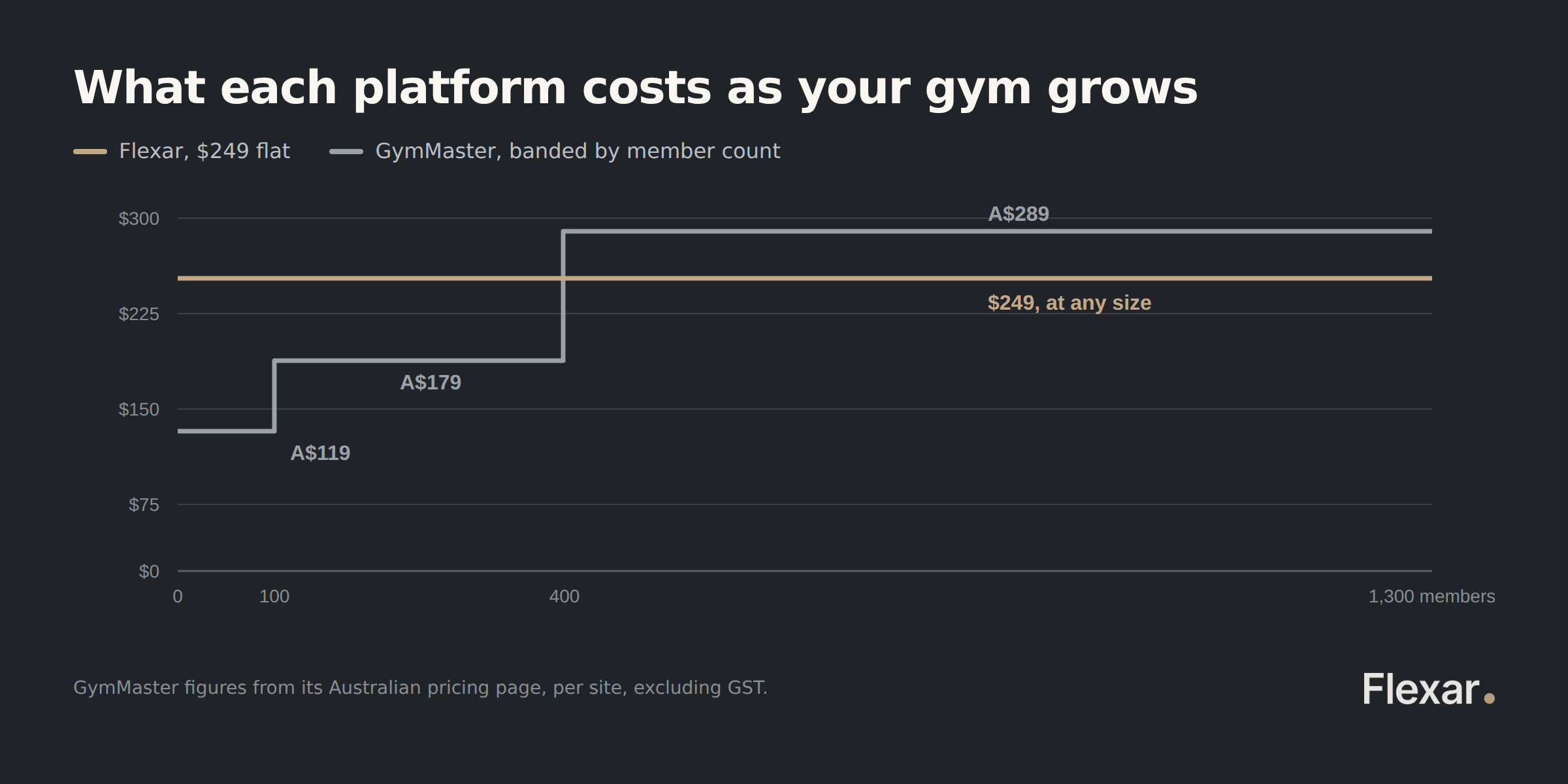
Flexar is $249 a month for Standard and $349 for Custom, and that figure does not move with your member count. A 200-member studio and a 900-member box pay the same. Growing your gym costs you nothing extra in software, which is the opposite of a model that charges you more for succeeding.
A few things sit outside the plan on GymMaster either way. Advanced website integration is A$30 a month, and a branded member app is A$200 a month with a A$600 setup fee. Flexar's Custom plan at $349 includes the white-label iOS and Android app published under your own name, with no setup fee.
The transaction fee, and why GymMaster cannot tell you
This is the biggest structural difference between the two, and it is not a feature.
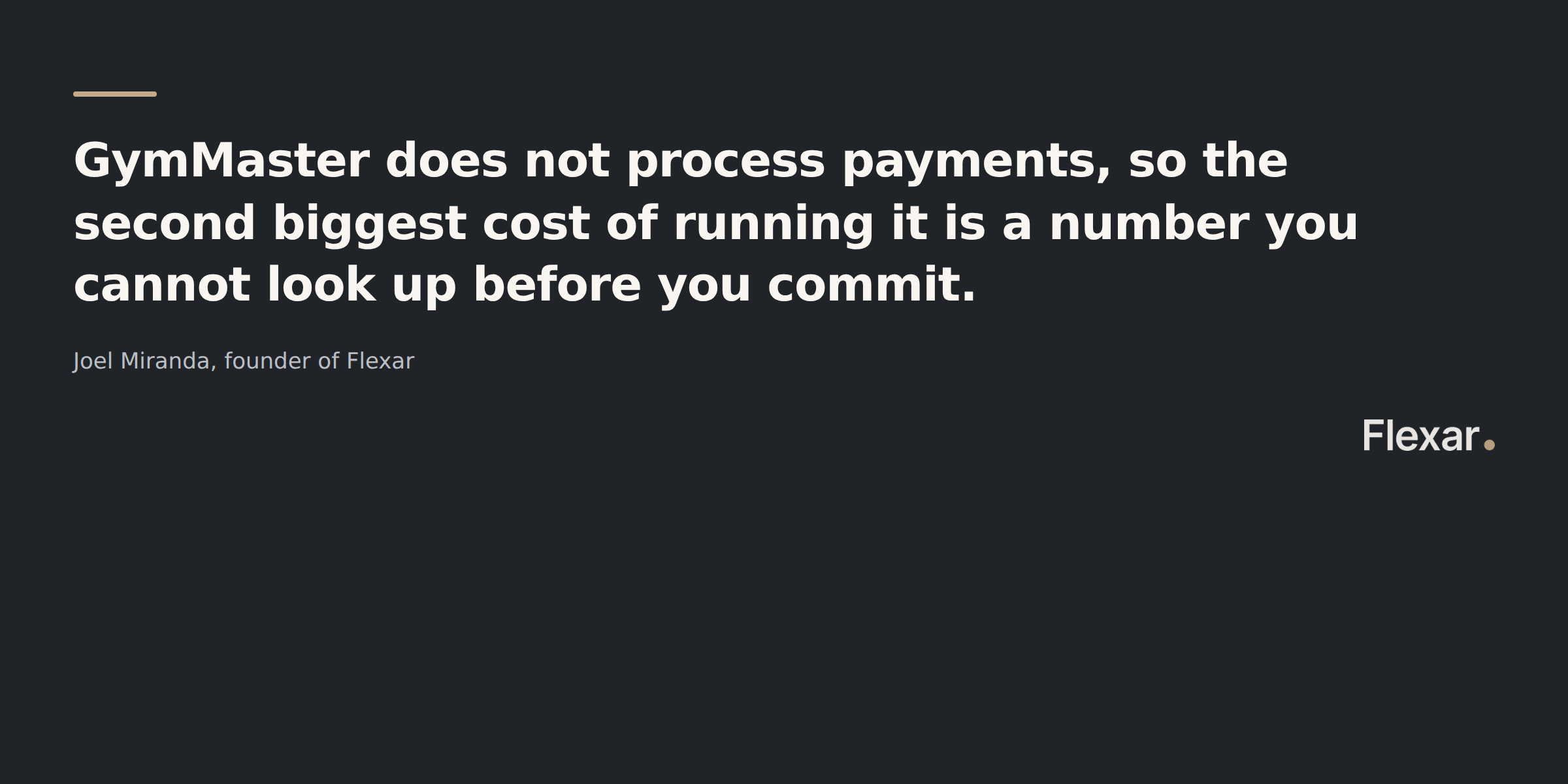
GymMaster processes payments through third-party billing providers rather than its own rails, and it integrates with several of them rather than one. What that means for you is that GymMaster cannot quote you a rate, because the rate belongs to whichever provider you are set up with and whatever you negotiate. Nothing appears on GymMaster's pricing page.
You can still find out roughly where those rates sit, because some of the Australian providers publish theirs. Ezidebit, one of the larger ones, lists 1.99% + 30c per transaction on recurring card payments on its Australian pricing page. That is the same structure as Flexar's rate, a percentage plus 30 cents, which makes it a clean comparison: 1.3% against 1.99%, or 0.69% of every card payment your gym takes.
Treat that 1.99% as the best case rather than the likely one. It is a rate published to win new business, which is the most competitive version a provider puts in public. What you are offered inside a private merchant agreement is not held to it, and there is nothing published for you to argue against.
That is the real cost of an unpublished rate. It has no ceiling. When a number is on a public page it is the same number for everyone, and you can hold a vendor to it. When it sits inside an individual agreement, what you pay comes down to how well you negotiate something you have no way to benchmark, and you will not find out you were on the wrong side of it until you have twelve months of statements to look at.
Three more things about that kind of arrangement are worth knowing before you sign, and they come from the providers' own fee documentation.
The rate is not one rate. Fees are set per payment method, so a bank debit, a Visa, a Mastercard and an Amex can each carry a different charge. Flexar's 1.3% + 30c is the same on every card type and on bank payments, because Flexar absorbs the difference on premium cards rather than passing it to you.
A failed payment carries its own fee. Separate from the transaction fee, a fixed amount is charged when a debit declines. Flexar never charges a dishonour fee of its own, and it verifies the funds are there before taking a bank payment so fewer debits fail in the first place.
All of it can be configured to be charged to the member rather than the gym. That is how these arrangements are commonly set up, which is why a member sees a fee on their statement, assumes you set it, and takes it up with your front desk.
What the transaction rate actually saves you
Here is the part that decides it, and it has nothing to do with features.
Say your members pay $50 a week. A 300-member gym puts about $780,000 a year through its billing. At Flexar's 1.3% that costs $10,140. At the 1.99% an Australian biller advertises, the same payments cost $15,522.
Now put the subscriptions next to it.
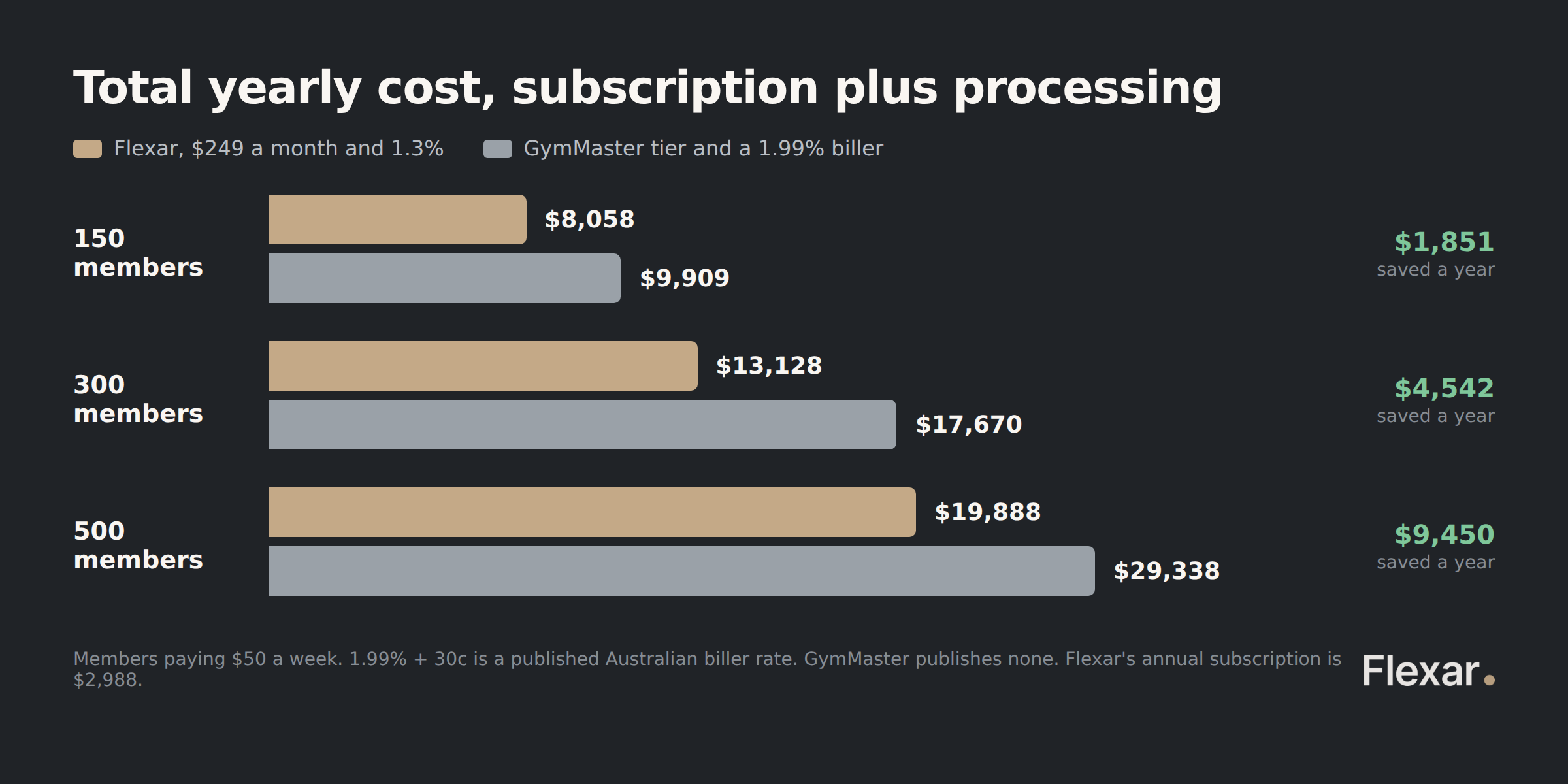
At 150 members. Flexar is $2,988 a year in subscription plus $5,070 in processing, so $8,058. GymMaster's A$179 tier is $2,148 plus $7,761, so $9,909. You are $1,851 a year better off on Flexar despite paying more for the software itself.
At 300 members. Flexar is $13,128 all up. GymMaster is $17,670. That is $4,542 a year, which is more than one and a half times Flexar's entire annual subscription of $2,988.
At 500 members. Flexar is $19,888. GymMaster's A$289 tier plus processing is $29,338. That is $9,450 a year, or more than three times what the software costs you.
And that is before the tools GymMaster does not have. A gym that needs staff rostering buys rostering software, because there is none in the platform.
The branded app is the clearest one, because GymMaster publishes the Australian price. A member app under your own name is a branded service on top of the plan, at A$200 a month plus a A$600 setup fee. So a 500-member gym wanting its own app is on A$289 for Professional plus A$200 for the app, which is A$489 a month before processing, and A$600 before it launches. Flexar's Custom plan is $349 a month with the white-label iOS and Android app inside it and no setup fee. That is A$140 a month cheaper with the app included, and A$600 you never spend.
Each of those is a separate line on your bank statement under GymMaster and no line at all under Flexar.
Two things about the numbers above. The 1.99% is a published Australian biller rate rather than a GymMaster figure, because GymMaster does not have one, so run it again with whatever you are actually quoted. And the gap widens rather than narrows as you grow, because a percentage compounds against your revenue while a subscription does not.
There is a reason so few platforms publish this number. For most of them the transaction fee is not a cost passed through to you, it is a revenue line. They take the provider's rate and add their own margin on top, commonly one to three percent, which turns a headline processing rate into a real cost closer to three to five percent. That margin never appears as an invoice, it is simply inside a percentage, and it grows on its own every time your gym does.
So when a platform cannot tell you its total rate, the problem is not only that you cannot budget. It is that nothing in the arrangement rules out a markup sitting inside it, and you have no way to test whether one is there.
The point stands whichever rate you end up on, and it only moves one way. A platform that publishes a flat rate hands you the difference every month, and hands you the ability to check it. A platform that cannot tell you the rate hands you a question mark on the largest recurring cost in the business after wages and rent. Flexar publishes 1.3% + 30c and adds no margin on top of processing, which is precisely why the number is allowed to sit on a public page.
What GymMaster does not have
GymMaster includes its features from Foundation upward, so the question is not which tier unlocks what. It is what exists at all.
Working from GymMaster's own features page, these do not:
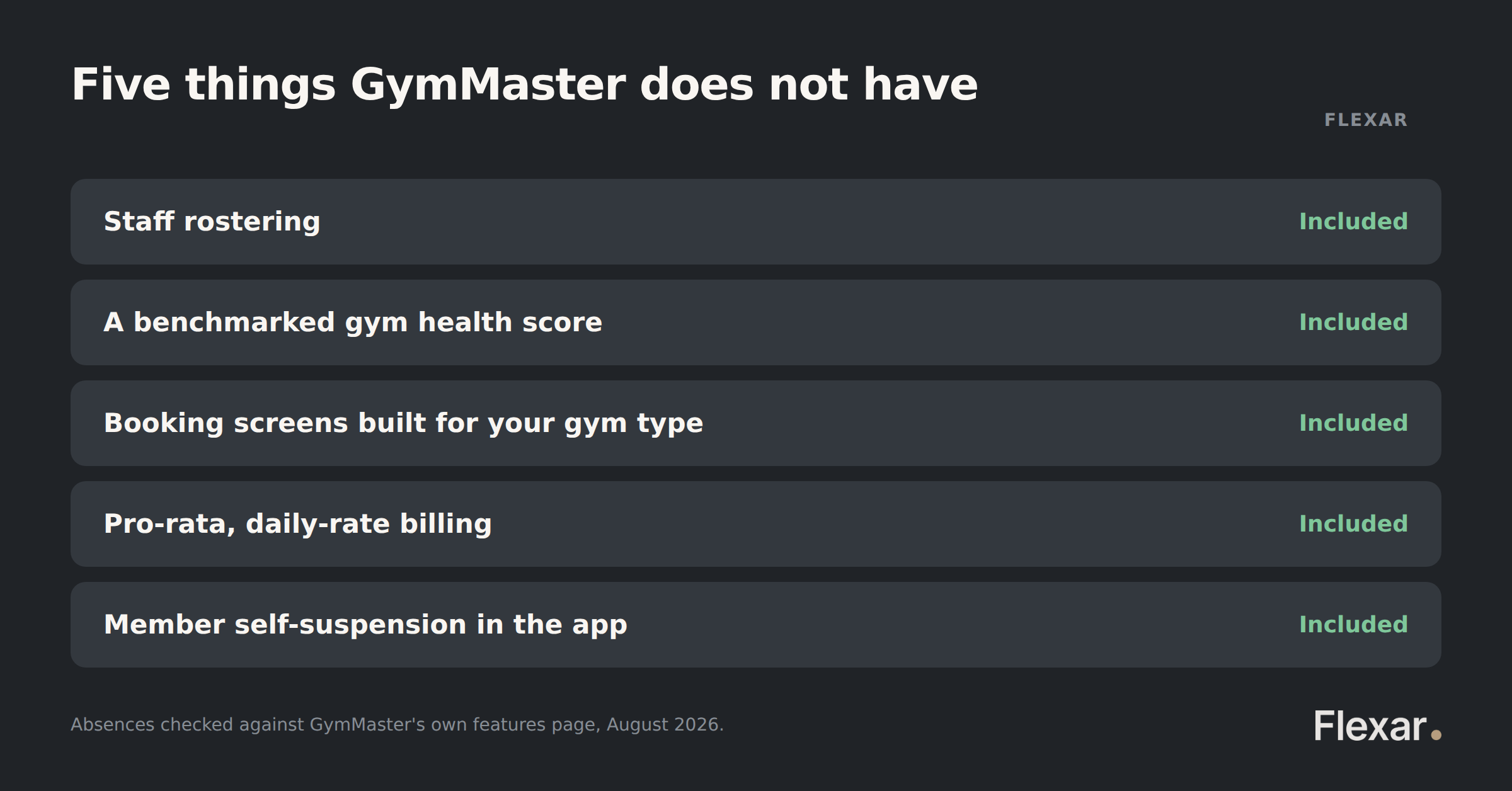
Staff rostering. There is no shift scheduling for coaches or front desk. For a gym running a class timetable with staff attached to it, that is a separate subscription and a separate calendar.
A gym health score. Nothing that scores the business as a whole or benchmarks it against comparable gyms.
Gym-type booking screens. No reformer bed or spot selection, no WOD library, no belt rank or sparring tools. It is one booking grid whether you run a reformer studio, a box or a mat room. They do have PT workout and measurement tracking, which is a different thing from a WOD library and I am not going to pretend otherwise.
Pro-rata or daily-rate billing. A member who joins on the 20th or freezes for nine days is not charged to the day.
Member self-suspension. No way for a member to pause their own membership from the app, so every freeze request lands on your front desk.
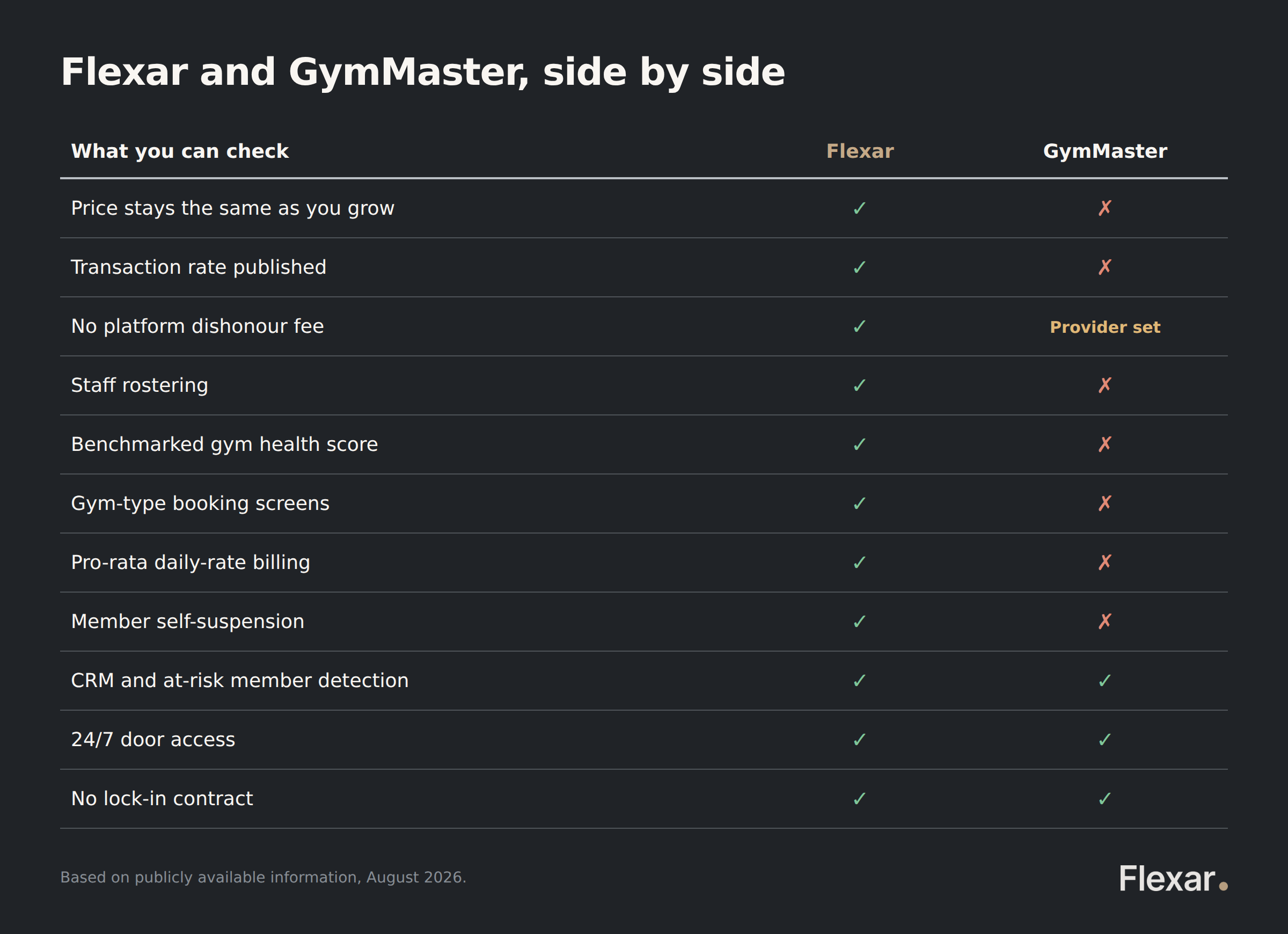
GymMaster does have CRM tools, at-risk member detection, reporting and point of sale, so the gap is not everywhere. It is in the five above, and those five are what separate a membership database from a platform that runs a coaching business.
Flexar has all five. FlexScore gives a live gym-health score across retention, financial, operations, community and growth, benchmarked against other gyms on the platform. Drag-and-drop rostering sits in the same calendar as your classes with payroll-ready exports. Booking screens change by gym type, so a Pilates studio gets a floor-plan bed picker, a box gets named WODs with 5RM and PR tracking, a martial arts gym gets belt rank and a sparring partner finder, and a recovery centre gets per-station capacity. Billing is pro-rata to the day, and members pause their own membership in the app with a day counter they can see.
What Flexar includes that usually costs extra
Flexar puts more than 65 features across ten categories into the $249 plan. The ones that move money:
Retention. FlexScore, plus AI smart alerts that watch attendance, payment and booking patterns and compare each member against their own history rather than a blanket rule. A three-times-a-week regular dropping to once gets flagged, and your coaches see it on the dashboard before they walk onto the floor.
The CRM, including the people who never joined. The full member record, a two-way inbox, and a lead pipeline running from enquiry through contacted, tour booked and trial to converted or lost. Meta leads land in it directly, first reply time is measured automatically, and follow-up sequences chase new enquiries and lapsed members with a cooldown so nobody is contacted twice.
Marketing attribution. A Meta Pixel installed on your signup pages and true cost per acquired member, rather than cost per click.
The perks and community layer. A member perks tab with discounts at partner businesses, owner announcements, referral tracking with automatic rewards, digital waivers, smart waitlists with auto-fill, attendance awards, and member feedback so an unhappy member tells you while they are still training.
The true cost of ownership
Compare six numbers rather than one:
- The monthly plan, at the member count you expect to be at in a year, not the one you are at today.
- The transaction fee, and whether anyone will put it in writing.
- What a member is charged when a payment fails.
- Setup and onboarding.
- Contract length and what leaving costs.
- The other apps you still pay for: rostering, a retention tool, a branded app, a waiver tool, a perks program.
Neither platform locks you in, so number five is a wash. Flexar adds a 30-day free trial with no card required.
Numbers one, two and six are where they separate. A growing gym pays GymMaster more every time it crosses a member band, pays an unpublished processing rate on every payment, and pays separately for rostering and a branded app. Flexar's figure holds as you grow, the rate is on the page, and both of those tools are in the plan.
Migrating from GymMaster to Flexar
Flexar imports members, memberships, attendance history and payment details where the previous provider allows it, so members are not asked to re-enter their card. GymMaster is named as one of the platforms Flexar can migrate from. Standard is self-serve with guides and support, and Custom includes done-for-you migration.
Because GymMaster's billing sits with a third-party provider, the practical question is who holds your payment tokens and what their release process is. Ask that before you start, not during.
Which should an Australian gym choose?
Flexar, and the fee is the reason before you even reach the features. A published flat rate against an unpublished one is worth thousands a year to a mid-sized gym, and at 300 members it covers the whole subscription with change left over.
Then there is everything the subscription buys. Rostering, retention scoring, the CRM and lead pipeline, marketing attribution and booking screens built for your gym type, all in the plan rather than absent from the product. The price does not climb when you sign your next hundred members. And 24/7 access is covered too, with entry tied to membership status so it switches off the moment a membership lapses, which is the one thing GymMaster is best known for.
If you are weighing the category more broadly, the best gym management software in Australia covers how the whole market compares, and Flexar vs Mindbody runs the same exercise against the largest platform in the category.
Key takeaways
- On a 300-member gym paying $50 a week, Flexar's flat 1.3% saves about $4,542 a year against the 1.99% an Australian biller advertises. Flexar's entire annual subscription is $2,988, so the saving is more than one and a half times the cost of the software.
- GymMaster prices by member count: A$119 up to 100 members, A$179 up to 400, A$289 up to 1,300, per site. Your software bill rises as your gym grows. Flexar is $249 regardless of member count.
- GymMaster does not process payments, so your transaction rate and any member dishonour fee are set by a third-party biller and are not published anywhere. Flexar publishes a flat 1.3% + 30c and charges no platform dishonour fee.
- GymMaster has no staff rostering, no gym-health score, no gym-type booking screens, no pro-rata billing and no member self-suspension. Flexar has all five.
- GymMaster does have a CRM, at-risk member detection, reporting, segmentation and referrals. It is not a thin product.
- Both offer no lock-in. GymMaster adds a 60-day money-back guarantee, Flexar a 30-day free trial with no card required.
Key facts
- GymMaster's published Australian pricing is A$119 a month per site for up to 100 members, A$179 for up to 400 and A$289 for up to 1,300, excluding GST.
- GymMaster publishes no transaction or processing rate, because billing runs through third-party providers rather than GymMaster itself.
- Flexar charges a flat 1.3% + 30c on every transaction, the same on every card type and on bank payments, with no platform dishonour fee.
- At 500 members the difference between Flexar's flat 1.3% and a 1.99% biller is about $9,450 a year, because a percentage compounds against revenue while a subscription does not.
- Ezidebit, one of the larger Australian billing providers, publishes 1.99% + 30c per transaction on recurring card payments. GymMaster publishes no rate of its own.
- Flexar's price does not change with member count, and its $349 Custom plan includes a white-label iOS and Android app with no setup fee. GymMaster charges A$200 a month plus A$600 setup for the same thing.
See how Flexar compares
The quickest way to see the difference is the Flexar comparison page and the published pricing, where the plan fee and the transaction rate are both on the page. If you run a box or a reformer studio, the CrossFit and Pilates gym-type pages show how the booking screens change. The 30-day trial needs no card.
Joel Miranda is the founder of Flexar, gym management software built for Australian gyms, studios and CrossFit boxes.
Published 9 August 2026.