How To Reduce Gym Churn: A 2026 Guide for Australian Gyms

Quick answer: You reduce gym churn by catching members before they quit. Track how often each member attends, reach out the week someone goes quiet, get new members to their first class fast, and keep billing simple so failed payments and freezes do not push people out.
Most gyms lose members the same way: quietly. A member stops coming, no one notices, and a few weeks later the cancellation arrives. By then the decision was made weeks ago. Reducing churn is mostly about two things: noticing that drop-off while you can still act on it, and giving members enough reasons to keep coming that fewer of them drift away in the first place. This guide explains what causes churn, the warning signs that predict it, and the specific fixes that work.
What gym churn is, and how to measure it
Churn is the rate at which members leave. To work out your monthly churn rate, take the number of members you lost during a month, divide it by the number of members you had at the start of that month, and multiply by 100. If you started March with 400 members and 20 left, your March churn was 5%.
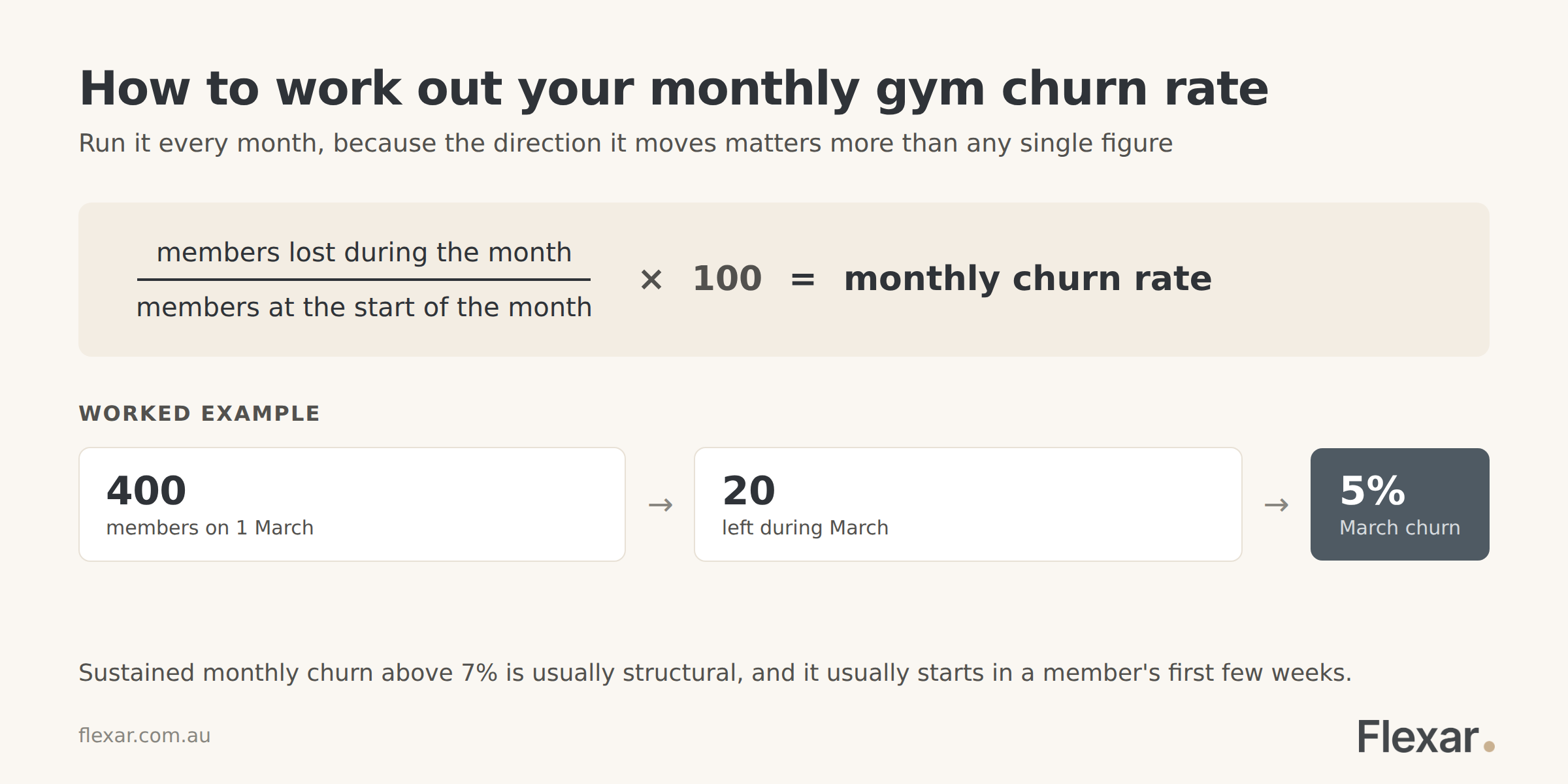
Track it every month, because one month on its own tells you very little and the direction it moves across a year tells you almost everything. Across the industry, member retention averaged 66.4% in the Health and Fitness Association's 2025 benchmarking report, which means roughly one member in three does not last twelve months. If your monthly churn sits above 7% for more than a quarter, the cause is usually structural rather than bad luck, and it is usually happening in a member's first few weeks.
The other number worth keeping next to churn is what a lost member actually costs you. When someone leaves you pay a second time for everything that got them through the door in the first place: the advertising, the trial, the sign-up admin, and the weeks of coaching attention before they were settled. That is why a one point drop in monthly churn is usually worth more to a gym than a one point rise in sign-ups, and why it is normally the cheaper of the two to achieve.
Why members actually cancel
When members are asked why they cancelled, three reasons come up most: cost, lack of time, and loss of motivation. Cost tends to lead the list, but it is worth reading that carefully, because "too expensive" usually means "I was not getting enough out of it to justify the price", not "the price was wrong". Someone training four times a week is getting their money's worth and rarely queries a small increase, while someone who has not been in for a month is paying for something they are not using and only needs a reason to stop.
That points to the real driver underneath the stated reasons, which is attendance. A member who keeps showing up keeps their membership. A member who stops showing up starts looking for a reason to cancel, and the price is the easiest one to reach for. Attendance is both the symptom and the lever, which is useful, because attendance is the one thing your gym already measures every single day at the door.
The warning signs that predict a cancellation
Three patterns predict a cancellation, and all of them are sitting in data your gym already collects every time someone scans in.
The strongest is a gap in attendance. Someone who trained three times a week and has not been in for a fortnight has almost always made the decision to leave well before they get round to telling you, so by the time the cancellation email arrives the decision is weeks old. That fortnight is the window where a message still changes the outcome, and once it closes you are asking someone to come back rather than asking them not to go.
The second signal is low frequency early on. A new member who is not getting to a couple of visits a week in their first month never forms the habit, and a membership without a habit attached to it is a direct debit waiting to be questioned.
The third is solo-only training. A member who only ever trains alone has no fixed time, no group, and nobody who notices they are missing. A member in a class has all three, which is why classes hold people better than open gym floors do.
The practical problem is that spotting these signals by hand does not scale past a few dozen members. Nobody is running that report on a Tuesday afternoon. This is the specific job gym software should be doing for you, and in Flexar it is the retention engine.
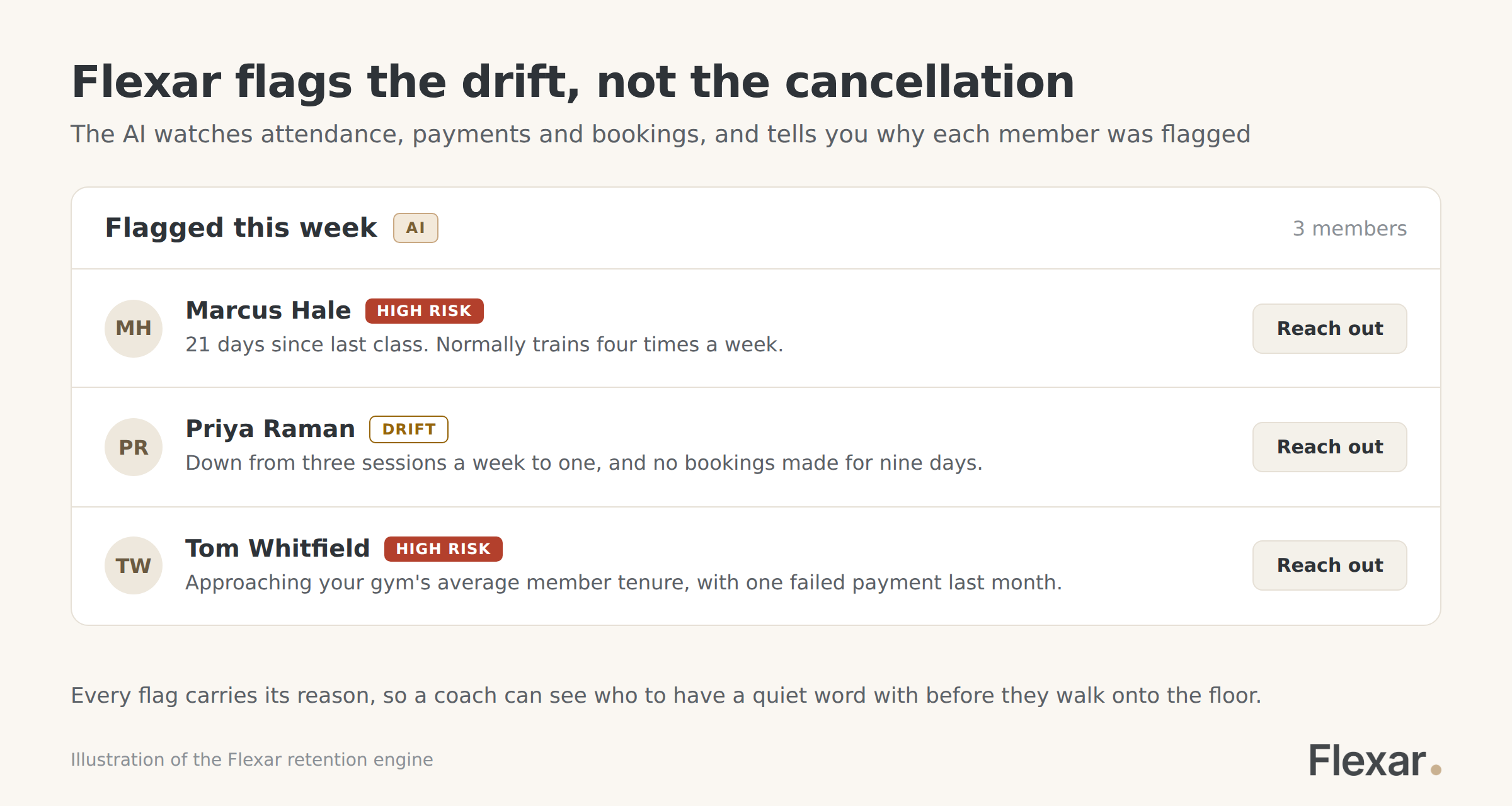
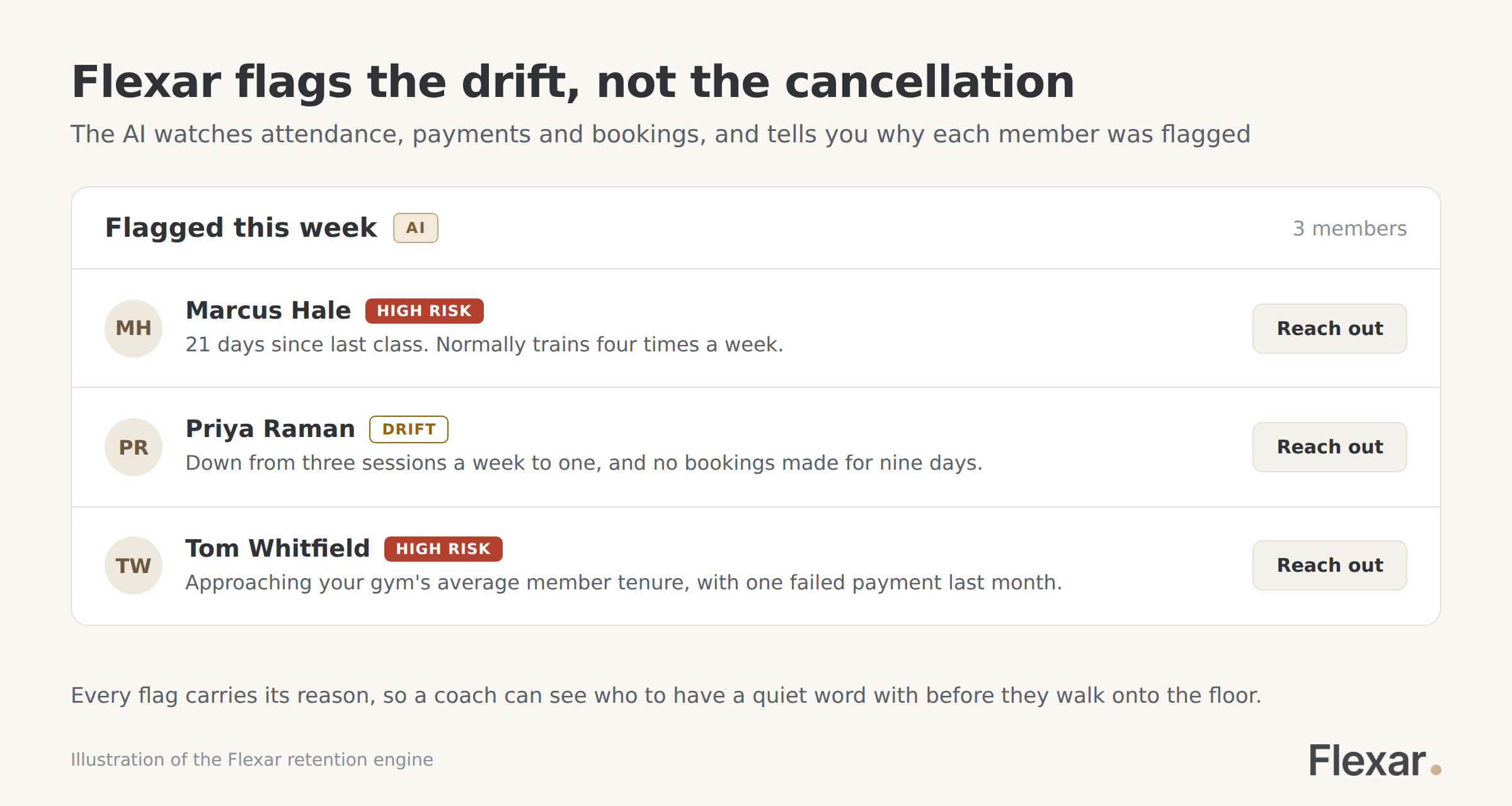
It runs on AI smart alerts, and the useful part is what they compare against. Instead of one blanket rule for the whole gym, the system learns each member's own pattern and watches three streams at once: how often they attend, whether their payments are going through, and what they are booking. A three-times-a-week regular dropping to once gets flagged. A once-a-week member carrying on exactly as they always have does not, because the comparison is against that member rather than a gym-wide average. The payment and booking signals matter as much as attendance, because a card that has started failing, or a member who has stopped booking ahead, often moves before the visits do.
When someone is flagged they appear on your dashboard, which means the response does not have to be a message at all. Your coaches can see who has gone quiet before they walk onto the floor, so the member who has dropped from three sessions a week to one gets a quiet word and some extra attention the next time they are in, rather than a text that reads like it came from a system. Where a message is the right call there is one ready to send, either to that member or to a smart segment if several people have drifted the same way at once. You can see how the alerts work on the Flexar retention engine page.
A system for reducing churn
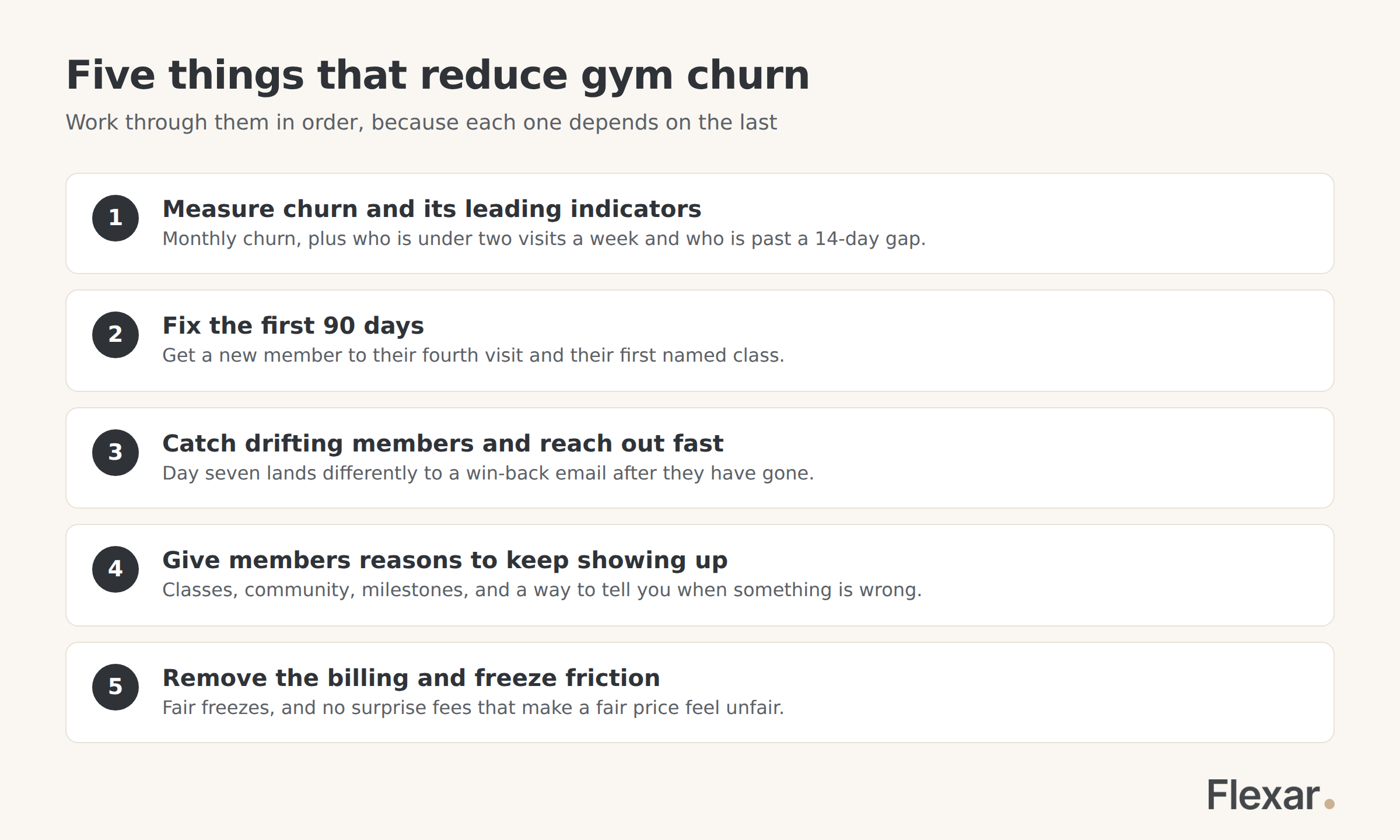
Reducing churn comes down to five things, done consistently. Here is the order I would work through them, because each one depends on the one before it.
1. Measure churn and its leading indicators every month
You cannot fix a number you are not looking at, so calculate your monthly churn rate and track three leading indicators alongside it: the share of members who visited fewer than twice in the past week, the share of new members not yet at two visits a week, and the number of members past a 14-day gap.
Those three matter because they move before churn does. Your churn number only tells you what already happened, whereas the count of members sitting on a two-week gap tells you what is about to happen and gives you time to act on it. Bear in mind that different fixes surface at different speeds: something tactical like faster follow-up shows up in your attendance data within a month or two, while a structural change like a new onboarding process takes a full quarter before it reaches the churn number. Give each change that long before you decide whether it worked.
2. Fix the first 90 days
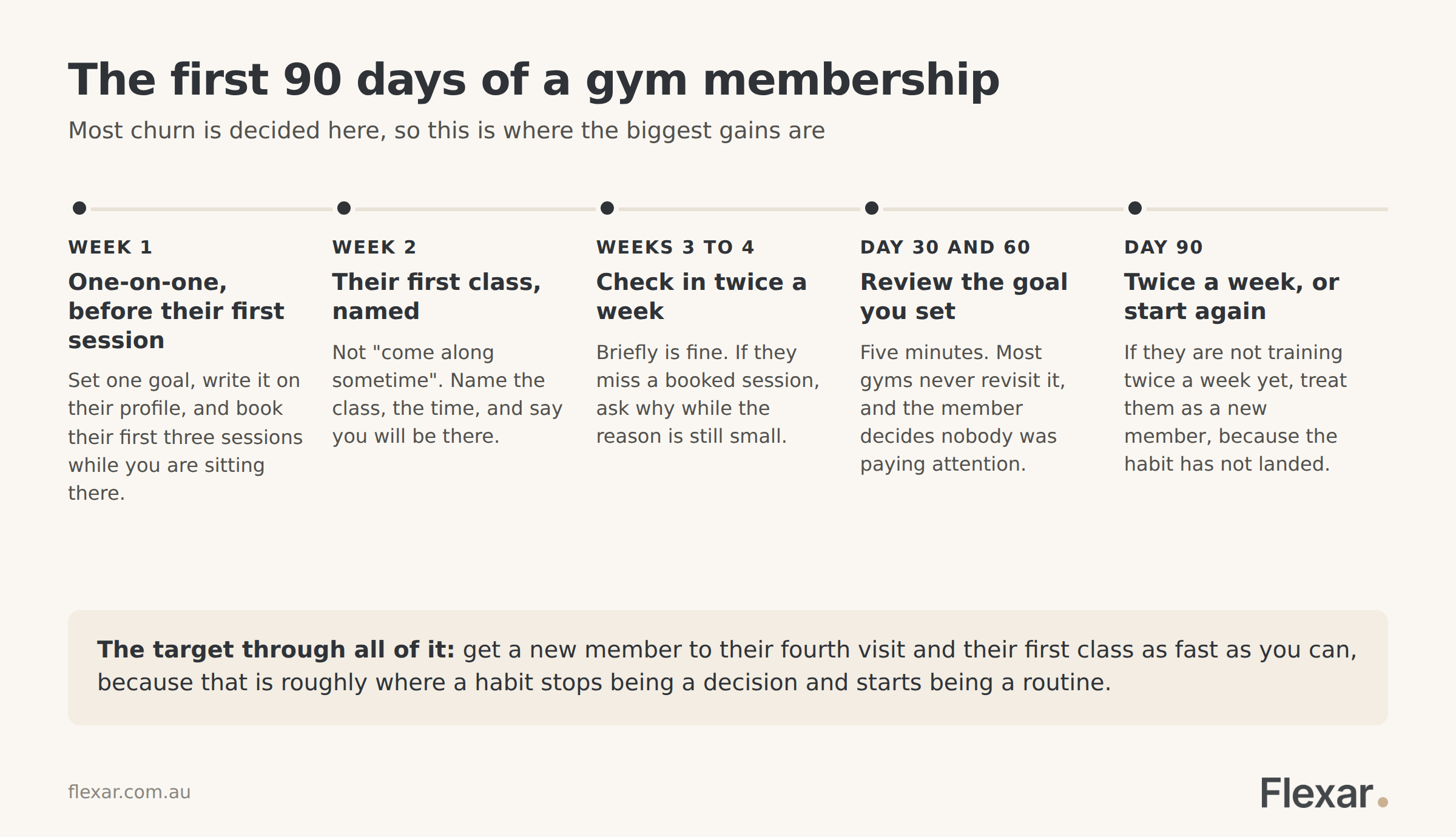
Most churn is decided early, so the first 90 days is where the biggest gains are. The goal is simple to state: get a new member to their fourth visit and their first class as fast as you can, because that is roughly where a habit stops being a decision and starts being a routine.
Here is a sequence that works, and it is deliberately unambitious, because an onboarding plan nobody follows is worth nothing.
Week one. Book the member a one-on-one before their first session, not after. Set one goal, write it on their profile, and plan their first three sessions with them so they arrive knowing what they are doing rather than standing near the rig deciding. Book those three sessions in while you are sitting there.
Week two. Get them into a class, and be specific about which one. "Come to a class sometime" gets ignored. "Come to the 6am Thursday, it is the one most new people start with and I will be there" gets attended. This is the single highest-value thing in the whole sequence, because it converts a solo member into someone with a time and a group.
Weeks three and four. Check in twice a week, even briefly. A message that says you noticed they came in on Tuesday does more than a newsletter. If they have missed a booked session, that is the moment to ask why, while the reason is still small and fixable.
Day 30 and day 60. Sit down for five minutes and review the goal you set in week one. Most gyms never revisit it, and the member quietly concludes nobody was paying attention.
Day 90. If they are training twice a week or more by now, they are through the risky part. If they are not, treat them as a new member again rather than an established one, because the habit has not landed.
3. Catch drifting members and reach out fast
Once onboarding is running, the ongoing work is catching the drop-offs. Set a rule and automate it: when a member passes a set number of days without a visit, they get contacted. A friendly "we have missed you this week, everything okay?" on day seven lands completely differently to a win-back email after they have already cancelled. One is a check-in from a gym they belong to. The other is a sales pitch from a business they have left.
The message does not need to be clever, it needs to be on time, and timeliness is a software job rather than a memory job. Flexar sends the alert and offers the message when the member's attendance drops, so the outreach happens on schedule rather than when someone remembers to look.
4. Give members reasons to keep showing up
Classes are the highest-value tool here, because a booked class is a commitment in a way that "I will go to the gym this week" never is. Fill your timetable with sessions your members actually want, and make booking a spot take seconds, because every extra tap between a member and a booking is a small argument for staying home.
Community does the same job more slowly. Members who know other members and hear from the gym between sessions stay longer, because leaving stops being a billing decision and starts being a social one. Announcements from the owner about events, challenges and milestones keep the gym present in a member's week rather than being a door they swipe through. Milestone recognition, like an attendance award at a member's fiftieth class, costs nothing and tells someone they were noticed.
There is also a quieter form of churn to catch here: the member who is unhappy but never says so. Someone who thinks a coach has been coasting, or whose favourite class time got dropped, will usually stop coming rather than complain, and you find out when they cancel. A feedback tool inside the member app fixes that by giving them an easy way to tell you. In Flexar a member can leave feedback from their phone, including flagging a coach who is not delivering or asking for a class or time, so the complaint reaches you while the member is still training and while you can still do something about it.
5. Remove the billing and freeze friction
Cost is the most-cited cancellation reason, so it is worth making sure you are not manufacturing cost problems of your own. Two things do it quietly.
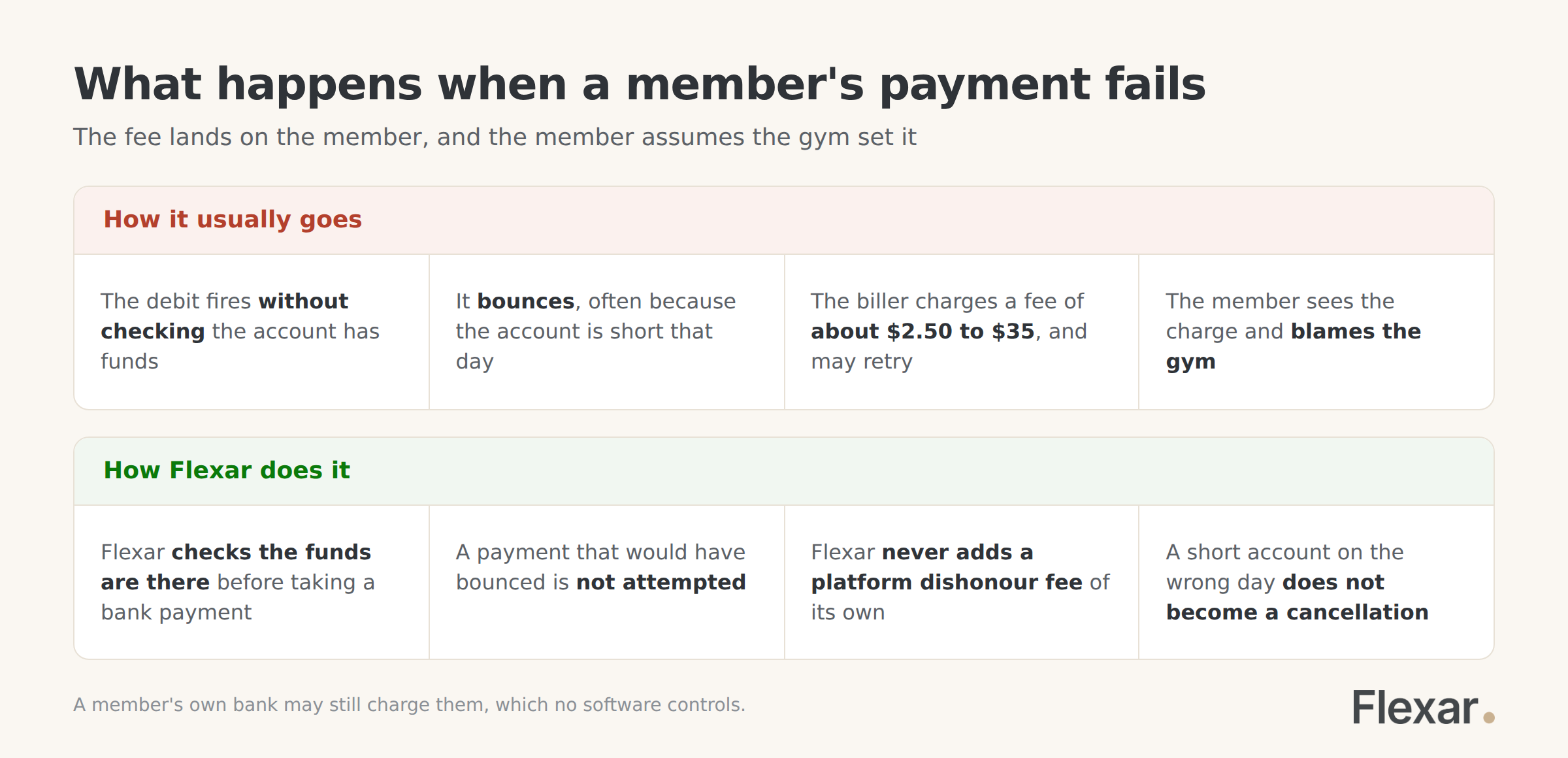
The first is failed payments and the fees attached to them. When a direct debit bounces, most billers charge the member a failed-payment fee, which in Australia runs from about $2.50 up to $35, and often retries and charges again. The member sees a charge they did not expect, assumes the gym set it, and starts questioning the membership over an amount smaller than a week's fees. Reducing failed payments at the source, by checking the funds are there before the debit runs, avoids both the fee and the bad feeling. Flexar does this for bank payments and never adds a platform dishonour fee of its own, so a short account on the wrong day does not turn into a cancellation. A member's own bank may still charge them, which no software controls.
The second is rigid freezes and rounded-up billing. A member who travels for nine days and gets charged for a full month feels overcharged, and remembers it at renewal. Billing that charges only for the days a member is active, and lets them pause in the app when life gets in the way, removes a common cancellation trigger and a common front-desk argument at the same time. Flexar bills pro-rata to the day and lets members self-suspend with a day counter they can see, which takes the fight out of freezes entirely. You can see how the billing works on the Flexar pricing page.
Warning signs and what to do about them
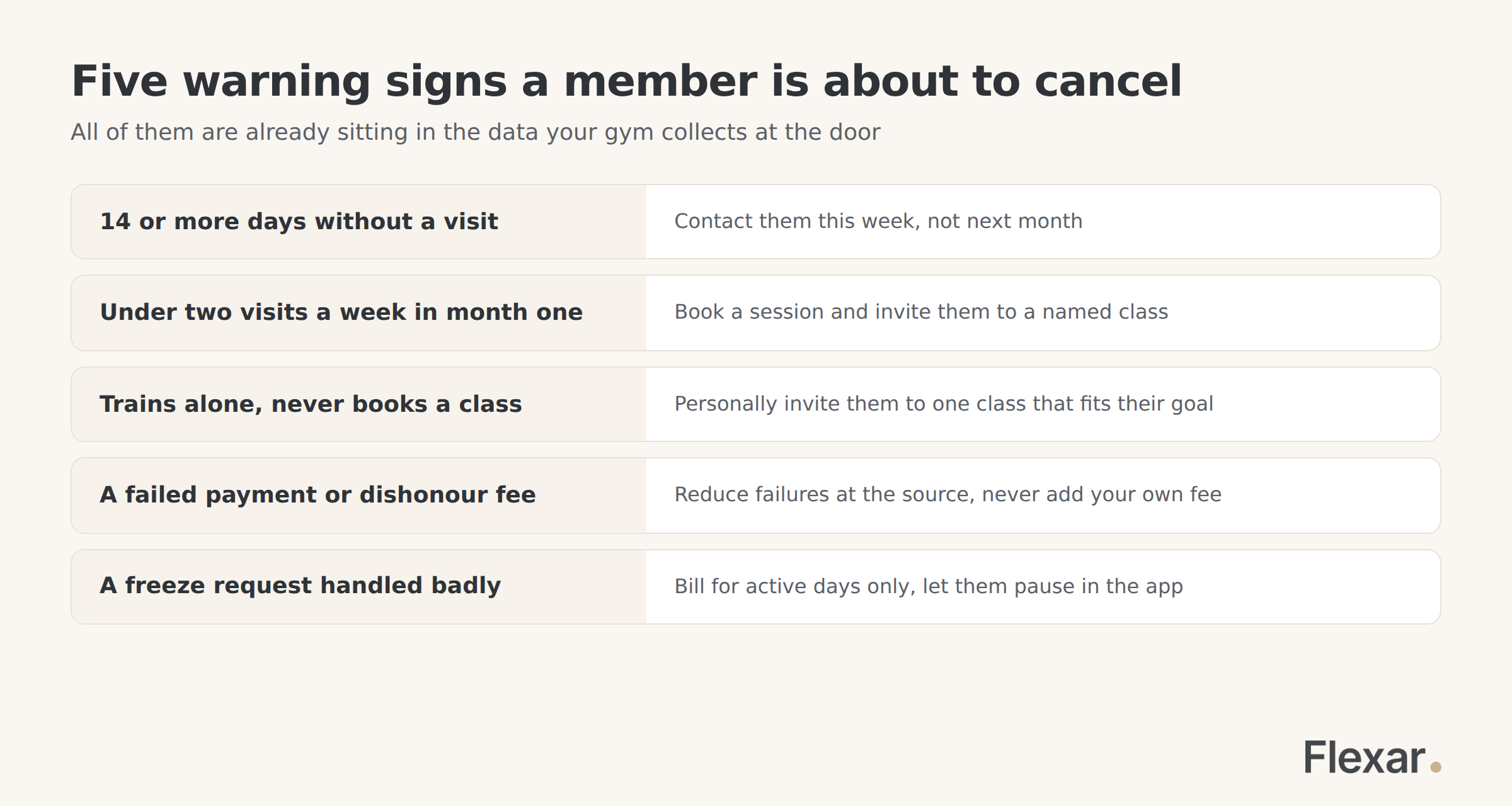
14 or more days without a visit. The member has usually decided already, so contact them this week rather than next month.
Fewer than two visits a week in month one. The habit is not forming. Book them a session, invite them to a named class, and check in twice a week.
Trains alone and never books a class. No fixed time, no group, and nobody who notices when they are missing. Personally invite them to one class that fits their goal.
A failed payment or dishonour fee. An unexpected charge that the member will blame on you. Reduce failed payments at the source, and never add a fee of your own on top.
A freeze request handled badly. A member who feels overcharged for time away. Bill for the days they are active and let them pause in the app.
Winning back the ones who already went quiet
Some members will lapse no matter how good your onboarding is. There is also a second group most gyms forget entirely: the people who signed up and never really started. They joined in January, came twice, and will cancel in March without anyone at the gym having spoken to them once.
Both get skipped for the same reason: nobody has a list of who they are, and nobody has a spare hour to build one. Flexar handles both with automated sequences. A sequence is a set of three messages that go out over several days on their own, so you set it up once and it keeps running without anyone remembering to send anything. Flexar ships one for members who have lapsed and another for members who joined and never got going, and you can build your own for the patterns that matter at your gym.
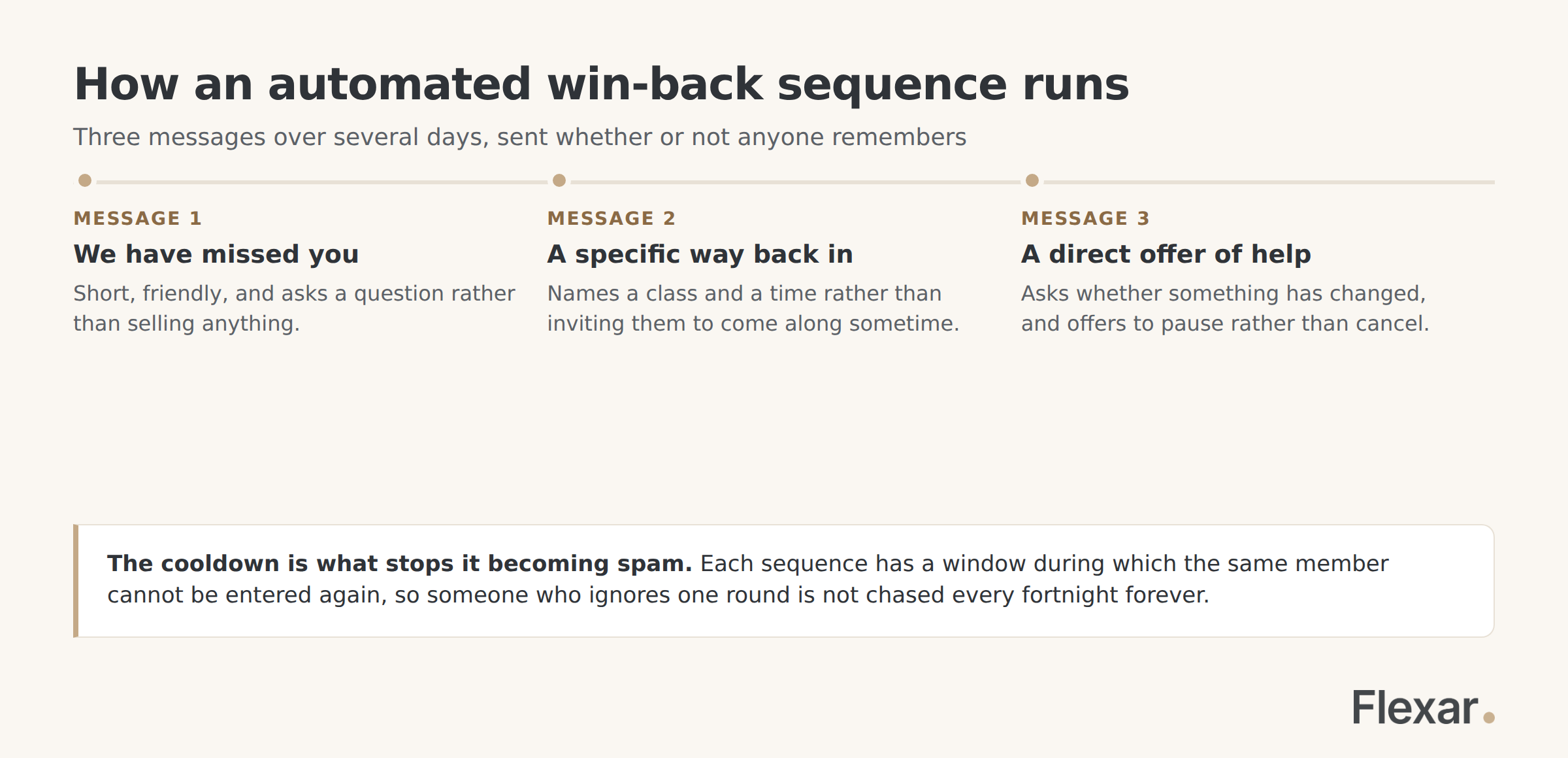
The detail that stops this becoming spam is the cooldown. Each sequence has a window during which the same person cannot be entered again, so a member who ignores one round does not get chased every fortnight forever. That is usually what goes wrong when a gym automates follow-up, and it is why most owners try it once and turn it off.
The same system covers enquiries who never joined at all, which is a different problem from churn but the same lost revenue. It sits in the Flexar retention engine alongside the attendance alerts, so the member who is drifting and the member who already drifted are handled in one place.
How Flexar helps reduce churn
Almost everything above is process, and any gym can run it on a spreadsheet if someone is disciplined enough to keep it up. What software changes is whether it is still happening in week nine, when the person who set it up is busy covering a class.
Flexar reduces churn in five concrete ways. Its AI smart alerts watch attendance, payments and bookings, and flag a member the moment they drop below their own pattern, so you intervene while it still matters. It scores your gym's health with FlexScore, benchmarked against other gyms on the platform. That way you can tell whether your churn is normal for your type of gym or a problem and which area to fix first. It makes class booking and check-in fast, so the behaviour that holds members is the easy one. It gives members a way to leave feedback from the app, so you hear about a problem while the member is still training. And it removes billing friction by checking funds before taking a payment, charging pro-rata to the day, and never adding a platform dishonour fee.
If you are weighing up platforms more broadly, the best gym management software in Australia covers how the whole category compares on retention tools, fees and contracts. The gym-type booking screens show how the timetable changes depending on whether you run a box, a reformer studio or a mat room.
Key takeaways
- Churn is decided early and quietly. The member stops attending first and cancels weeks later, so the whole game is noticing the drop-off in time.
- The alert has to compare a member against themselves. A gym-wide rule misses the regular who halved their visits and pesters the once-a-week member who never changed.
- Attendance is the number to protect. Cost, time and motivation are what members say, but the members who cancel are almost always the ones who had already stopped coming.
- The first 90 days matter most. Get a new member to their fourth visit and their first named class, then review their goal at day 30 and day 60.
- Classes and community hold members because they turn a solo habit into a commitment with a time and a group attached.
- Billing friction pushes members out. Reduce failed payments at the source, never charge your own dishonour fee, and bill for the days a member actually trains.
- Chase the ones who already went quiet, including the members who joined and never really started. Automated sequences with a cooldown do this without anyone remembering to.
Key facts
- Member retention averaged 66.4% for the year across the industry, according to the Health and Fitness Association's 2025 Fitness Industry Benchmarking Report. Roughly one member in three does not last twelve months.
- In Australia, a failed direct debit typically triggers a fee to the member of about $2.50 up to $35, and billers often retry and charge again.
- A member who has not trained in a fortnight has usually made the decision to leave before the cancellation arrives.
- Members who attend classes hold better than solo-only members, because a booked class supplies a fixed time, a group, and people who notice an absence.
- Flexar's AI smart alerts compare each member against their own attendance, payment and booking pattern rather than applying one blanket rule across the gym.
- Flexar charges a flat 1.3% + 30c on every payment, adds no platform dishonour fee, and bills pro-rata to the day.
Reduce churn with software that watches attendance for you
The fixes in this guide work, but only if they happen every week. See how Flexar flags at-risk members and handles billing without the fees that push members out on the Flexar retention engine page. If you want to try it on your own members, the 30-day free trial needs no card.
Joel Miranda is the founder of Flexar, gym management software built for Australian gyms, studios and CrossFit boxes.
Published 9 August 2026.
Common questions
What is a good churn rate for a gym?
Under 3% a month is excellent and 5 to 7% is common. Sustained above 7% usually points to a structural problem in the first weeks of membership rather than bad luck. Track it monthly, because the trend matters far more than any single month.
What is the biggest cause of gym member churn?
Low attendance. Members cite cost, lack of time and loss of motivation, but the members who cancel are almost always the ones who had already stopped coming. A member training twice a week rarely cancels over price.
How do I know which members are about to cancel?
Watch attendance. A member who has not visited in a fortnight, a new member not reaching two visits a week, and a member who never books a class are the three clearest signals. Gym software that tracks attendance can flag these automatically.
How long does it take to reduce churn?
Tactical changes like faster follow-up show in attendance data within a month or two. Structural changes like new onboarding take a full quarter to reach the churn number, so give each change time before judging it.
Does billing affect churn?
Yes. A failed direct debit triggers a fee the member blames on the gym, and a freeze that charges for a full month feels like being overcharged. Reducing failed payments at the source and billing only for active days removes two common cancellation triggers.