Gym Membership Pricing Guide (Australia, 2026)

Price a gym membership from two numbers: what a member costs you to serve, and what your result is worth to them. Your price belongs between those two, in two or three tiers, reviewed every quarter against conversion, revenue per member and churn.
Almost nobody prices that way. Most owners look at a competitor and land a little under, which feels safe and quietly caps what the gym can earn, because a competitor's price tells you nothing about what your gym costs to run or what your members would happily pay. Pricing is one of the few levers that moves profit without needing a single extra member, so it is worth the afternoon it takes to get right. This guide covers what Australians actually pay, the models and when each fits, a method for setting your own number, the psychology that changes how a price is read, and how to raise prices without losing people.
What Australians actually pay for a gym membership
Australians now spend an average of $77 a month on gym memberships, according to Canstar research published in March 2026 covering more than 1,300 gym-goers. That is up from around $63 a month in their earlier research.
Read that number carefully before you price against it. It works out to roughly $18 a week, and it is a national average across every kind of gym, including the 24/7 franchises that hold more members between them than everyone else combined. If you run a coached studio, that figure is not describing your market. It is describing theirs.
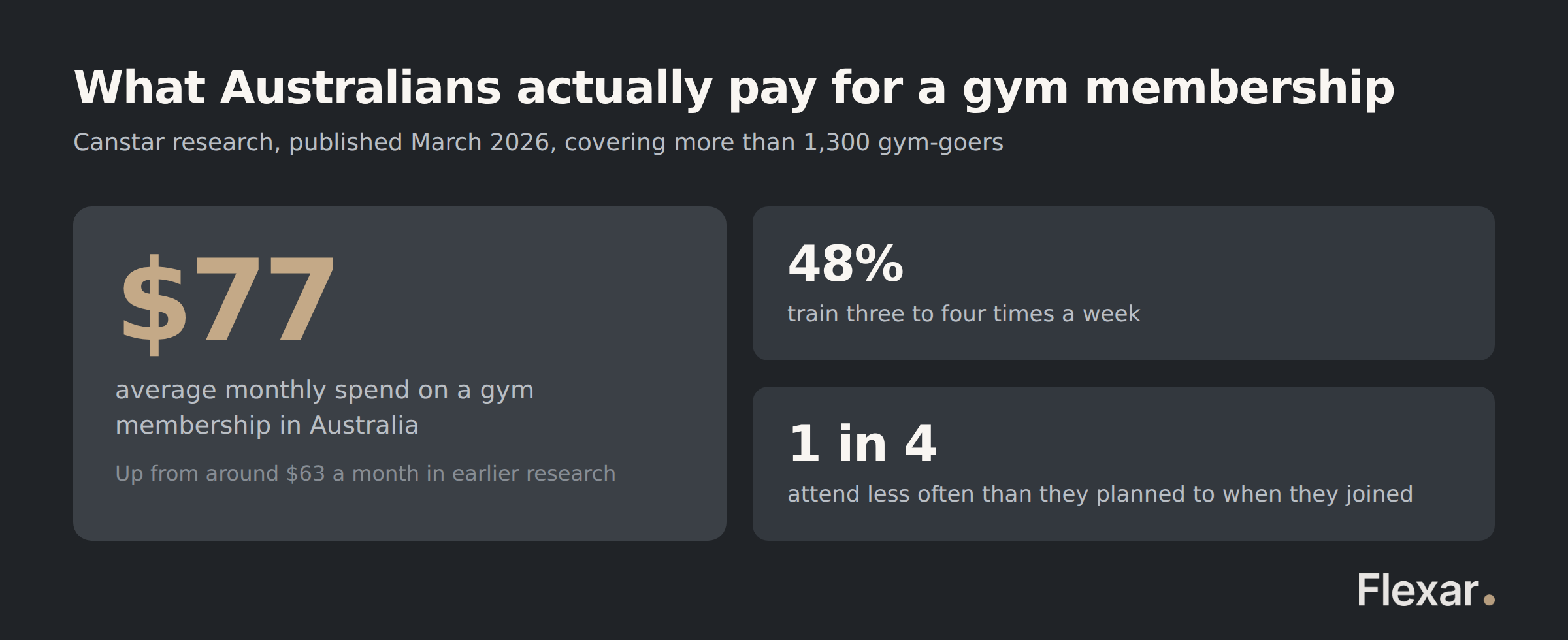
Two other findings in the same research matter more for pricing than the average does. Nearly half of members, 48%, train three to four times a week. And one in four said they attend less often than they planned to when they joined. Those two numbers describe the two halves of almost every gym's member base: a committed core who use the place properly, and a quarter who are paying for something they are not really using. Your pricing model decides which of those groups you are built around, and most owners never make that choice deliberately.
Australian gyms quote weekly, so it helps to see the market in the terms members actually read on a website. Roughly:
Budget 24/7 chains, about $10 to $20 a week. What the member buys is access. A room, some equipment, and a fob that works at 3am. There is little or no coaching, and the model depends on signing up more members than the floor could ever hold at once.
Mid-tier and coached gyms, about $40 to $60 a week. Group classes, programming, and a coach who knows your name. This is where most CrossFit boxes and full-service studios sit.
Premium and boutique, $80 a week and up. Small-group reformer, high-end coaching, or a club selling facilities as much as training. Some studios at this end price per class rather than weekly, which makes the comparison harder for members and is sometimes the point.
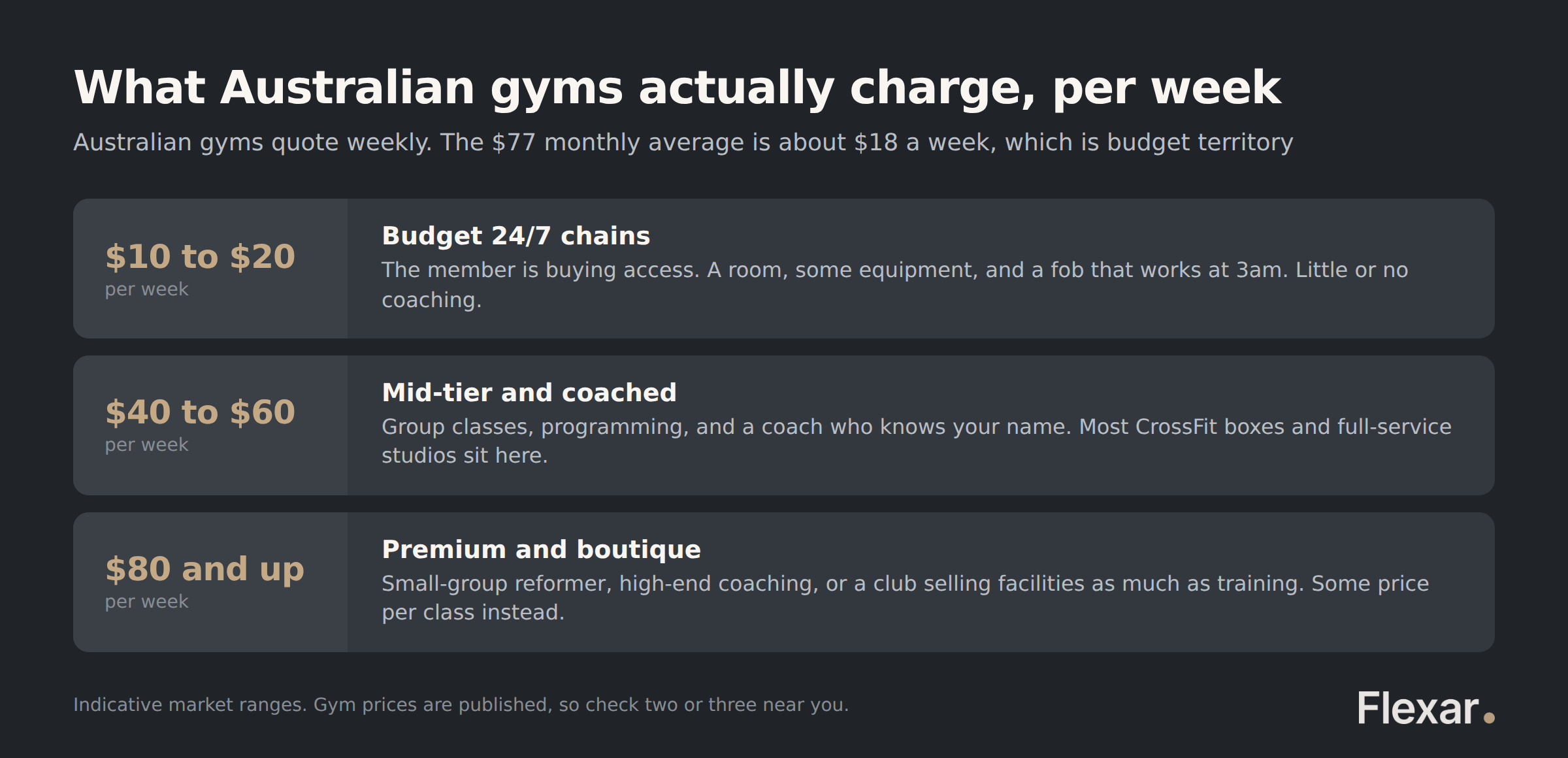
Where you sit in that spread decides which members you attract, which is the part owners underestimate. Price like a budget gym and you inherit price-sensitive members who leave the moment something cheaper opens nearby. Price like a boutique and you have to keep delivering a boutique experience, because a member paying $80 a week notices when the coaching gets thin.
The pricing models, and when each one fits
The model is the shape of the offer, and it is a separate decision from the number. Most Australian gyms run one of these, or a combination.
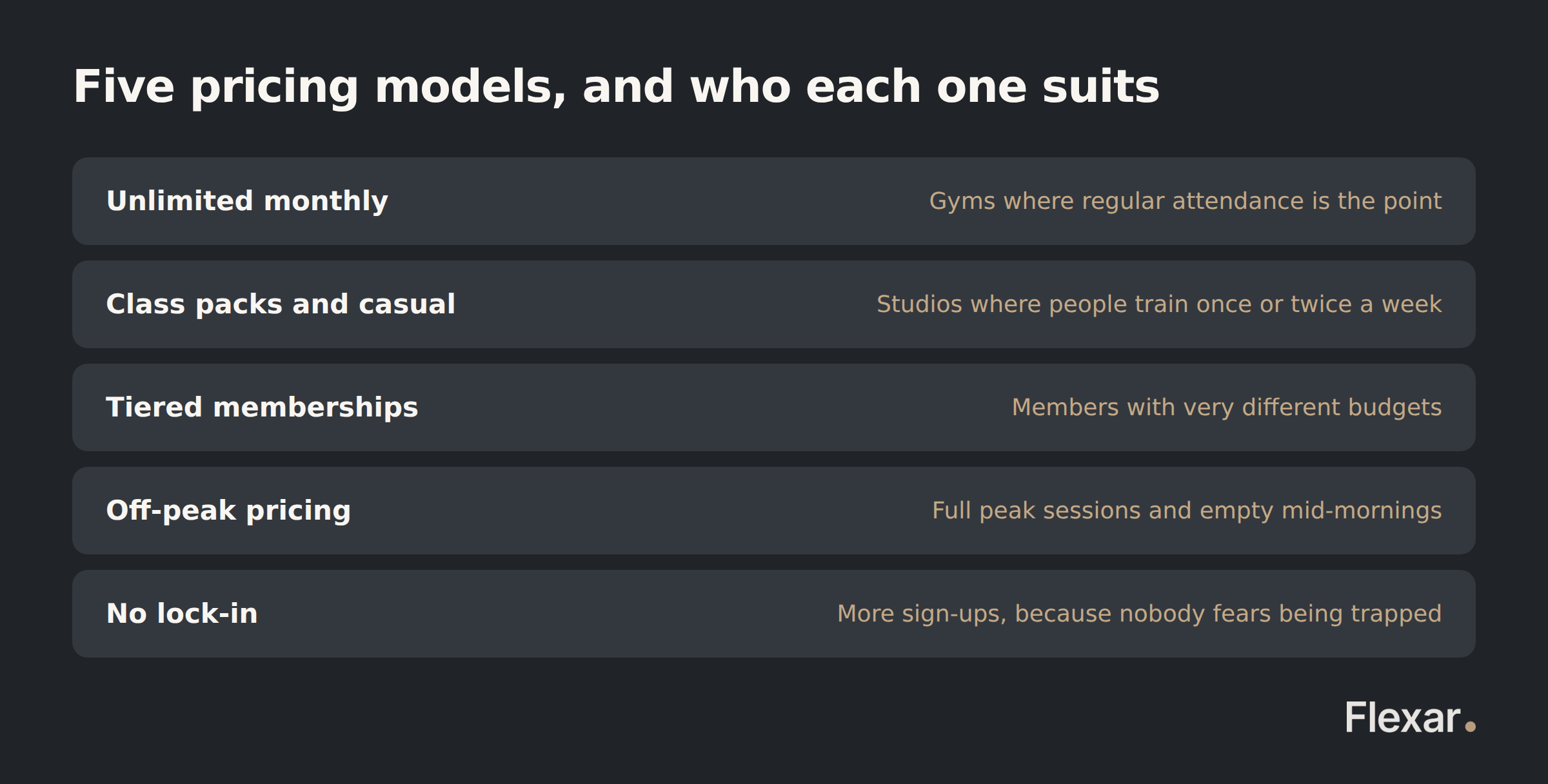
Unlimited monthly membership. The member pays a set amount and trains as often as they like. It is simple to sell, it gives you predictable recurring revenue, and it suits gyms where regular attendance is the point, such as a CrossFit box or a full-service gym. The risk is the quarter of members who attend less than they planned to: they keep paying for a while, feel increasingly guilty about it, and then cancel in one go. Unlimited models need someone watching attendance, not just billing.
Class packs and casual entry. The member buys a block of ten classes and uses them over a few months, or pays per class. This suits studios where people train once or twice a week, and it lowers the barrier for someone not ready to commit to a monthly debit. The trade-off is that revenue becomes lumpy and unused packs create awkward conversations, so packs usually work best sitting alongside a membership that nudges the regulars onto a monthly plan.
Tiered memberships. Two or three levels at different prices and levels of access, such as off-peak only, full access, and full access plus extras. Tiers let members sort themselves by budget and usage, which captures both the price-sensitive member and the one who would happily pay more, instead of forcing everyone through a single price.
Off-peak pricing. A cheaper rate for members who train in your quiet hours. This fills capacity you are already paying rent on without discounting your peak price, because the member who can only come at 6pm still pays full rate. It only works if your peak sessions are genuinely full and your mid-mornings are genuinely not.
Contract versus no lock-in. A twelve-month contract buys you certainty, usually in exchange for a slightly lower monthly price. Month-to-month converts more new members because it removes the fear of being trapped, which matters more every year as members get used to cancelling anything from an app. Whichever you pick, how you handle freezes and cancellations will affect your churn more than the contract length does.
How to set your price: a five-step method
Each step produces a number, and your final price sits inside the range the first two create.
1. Work out your cost floor
Add up what it costs to run the gym for a month, including rent, wages, equipment finance, insurance, software, utilities and marketing. Divide that total by the number of members you have, or realistically expect to hold. The result is what each member costs you to serve, and it is the floor your price cannot go below.
Worked through: if your monthly costs are $20,000 and you have 200 members, each member costs you $100 a month to serve. A $90 membership loses you ten dollars every time someone signs up, and signing up more of them makes it worse rather than better.
2. Set your value ceiling
The ceiling is what a member will pay for the result you deliver, and it has nothing to do with your costs. A reformer studio that actually fixes someone's back can charge far more than a room containing the same machines and no coaching, because the member is buying the outcome rather than the equipment.
To estimate it, look at what your members already pay elsewhere for the same result. A physiotherapist, a personal trainer, or the studio two suburbs over are all reference points your members are using whether you like it or not. The stronger and more specific your result, the higher the ceiling sits.
3. Work back from a revenue target
Decide what the gym needs to earn, then check whether the arithmetic works. If you want $45,000 a month and you can realistically hold 220 members, your average revenue per member needs to be about $205 a month, which is roughly $47 a week. If that sits above what your market will bear, you need either more members or a different offer, and it is far better to find that out now than a year in.
That figure, average revenue per member, is the one to plan around, because it ties your price, your model and your member count together in a single number. It is easy to find later too: total membership revenue divided by member count.
4. Choose your model and tiers
With a floor, a ceiling and a target, pick the model that matches how your members actually train and set two or three tiers inside the range. Do not build a tier you cannot deliver, and do not add tiers to fill out a table, because every extra option makes the decision harder and some members respond to a hard decision by making none.
5. Test, then review every quarter
Set the price and watch three numbers over the following quarter: how many enquiries convert at the new price, your average revenue per member, and your churn. If conversion holds steady and revenue per member rises, your old price was too low.
This is the step most gyms skip, because pulling those three numbers out of a spreadsheet every quarter is tedious enough that it never happens. Software that reports revenue per member and shows which tier people actually choose turns it into a five-minute read. You can see the reporting on the Flexar features page.
How many tiers, and how to structure them
Two or three tiers is the sweet spot. A single price leaves money on the table, because the member who would gladly have paid more had nowhere to go. Five or six options overwhelm people, and an overwhelmed buyer often picks nothing at all.
The reliable structure is good, better, best. Build three options where the middle one is the plan you actually want members on, then price the other two so they point at it. The top tier earns its place even if almost nobody buys it, because it changes how the middle one reads. A $89 plan sitting on its own can look steep, while the same $89 plan sitting next to a $129 option looks sensible. That is anchoring, and it works because people judge a price against the prices beside it rather than in isolation.
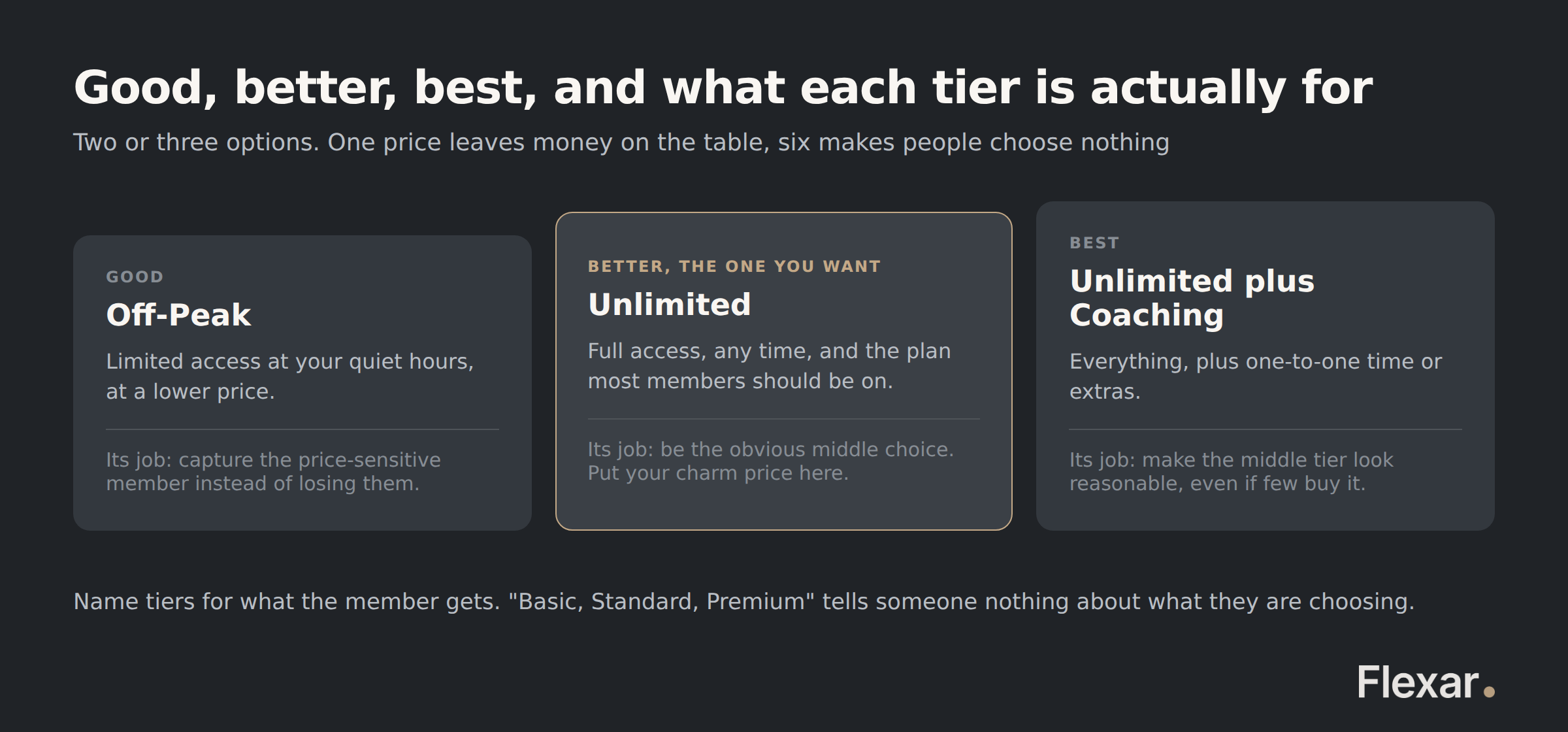
Name your tiers for what the member gets. "Basic, Standard, Premium" tells someone nothing about what they are choosing. "Off-Peak", "Unlimited" and "Unlimited plus Coaching" let a member sort themselves without having to ask anyone at the desk.
Pricing psychology that changes behaviour
Two tactics are worth using, because they change how a price is read rather than just how it looks.
The first is charm pricing, which means ending a price just below a round number: $79 rather than $80. People read the leftmost digit hardest, so $79 registers as closer to $70 than to $80 despite being a dollar different. Use it on the plan you most want members to choose, and not on all of them, because a price list where every number ends in 9 stops reading as a price list and starts reading as a sales tactic.
The second is anchoring, described above. Show the higher number first so the one you want looks reasonable next to it. You can anchor with your tier order, or by showing the annual price beside the monthly one so the monthly figure looks small.
A caution on both. They change how a fair price is read. They do not rescue a price the experience cannot justify. If the gym does not match the number, psychology wins you the sign-up and then loses you the member four months later, which costs considerably more than the discount you were trying to avoid.
Pricing the intro offer
Almost every gym runs some kind of entry offer, and it is the price most often set by copying whoever is nearby. It deserves the same thinking as the membership itself, because it does a different job.
The intro offer is not there to make money. It is there to get someone through enough sessions that they form a habit, which means the only question that matters is whether the offer is long enough to reach that point. A single free session almost never does it, because one visit tells a person very little and asks nothing of them. Two or three weeks of proper access, ideally with a coached session and a class booked in, gives them a real run at it.
Price it low enough to remove the excuse and high enough that people turn up. Free trials attract the highest volume and the worst attendance, because something that costs nothing is easy to skip on a cold morning. A small paid intro, even twenty or thirty dollars, filters for intent and gets noticeably better attendance from the people who take it.
Then decide in advance what happens at the end. An intro offer with no defined next step is where most of them leak: the fortnight finishes, nobody has the conversation, and the person quietly stops coming. Book the conversion conversation before the trial starts, at a specific time in the final week, and treat it as part of the offer rather than an afterthought.
One thing not to do is let the intro price become the anchor for the membership. If someone pays $29 for a fortnight and then sees $55 a week, the second number lands badly. Talk in weekly terms if that helps, and make sure the value conversation happens before the price does.
Common pricing mistakes
Competing on price. Setting your price just under a competitor starts a race you cannot win against a chain with a thousand members per site, and it attracts exactly the members who will leave when someone undercuts you. Compete on the result instead.
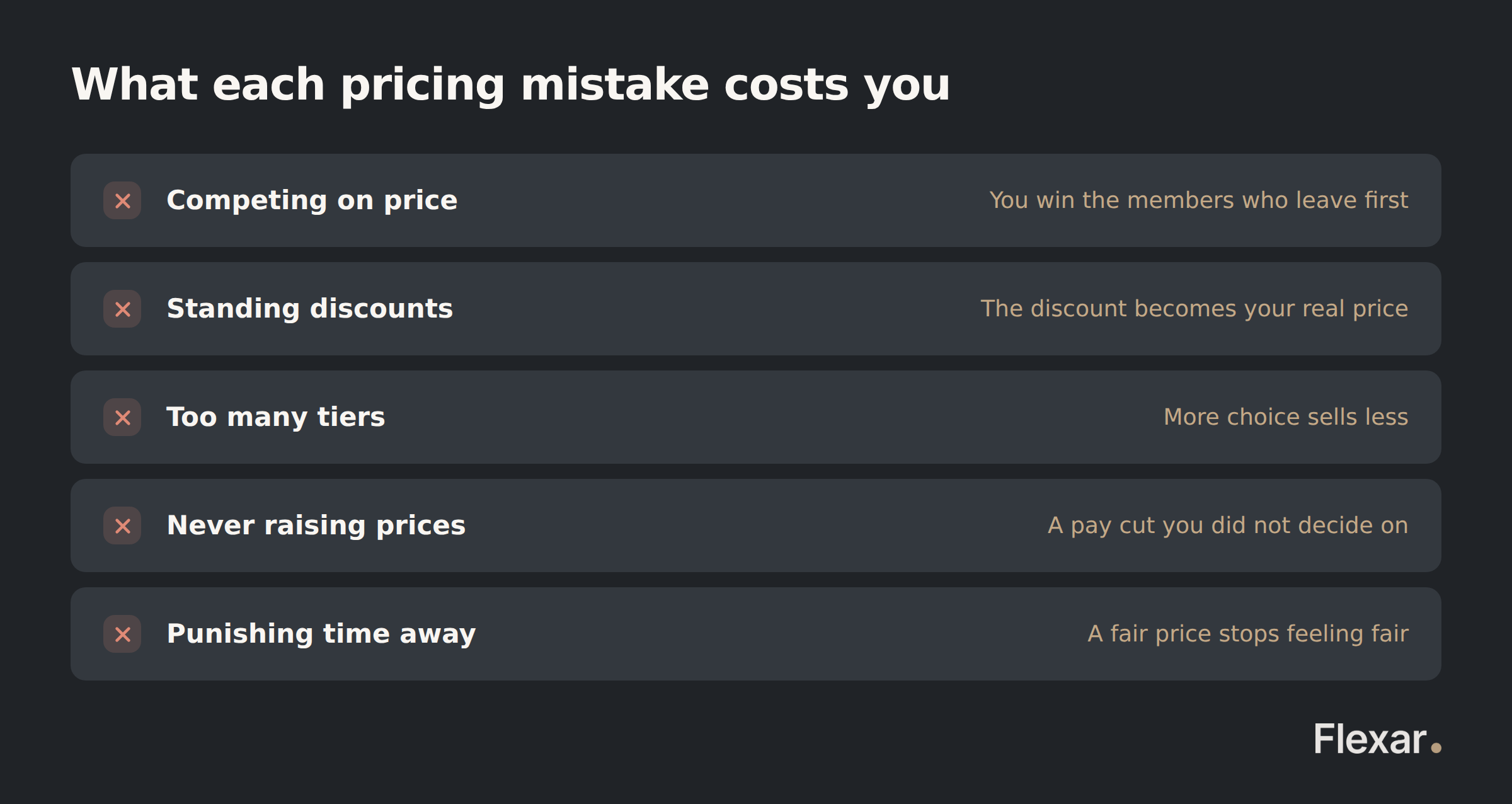
Standing discounts. A permanent offer trains members to wait for the next one, and it quietly lowers what everyone pays, including the people who would have paid full price without hesitating. If you run an offer, give it an end date and a reason.
Too many tiers. Every additional option adds a decision. Past three, conversion generally falls rather than rises.
Never raising prices. Costs rise every year, so a gym holding the same price for five years is getting cheaper in real terms while its margin thins. Small regular rises are far easier to hold than one large correction after five years of avoiding it.
Punishing time away. Charging a member for a full month when they froze for nine days, or letting a failed payment turn into a fee, makes a fair price feel unfair. The number the member agreed to should be the number they pay. Flexar bills pro-rata to the day and never adds a platform dishonour fee, so a holiday or a short account on the wrong day does not undo the pricing work you just did. You can see how the billing works on the Flexar pricing page.
How to raise prices without losing members
A price rise done properly loses very few members, because people stay for the result and the room, not for the last five dollars. The method is what decides it.
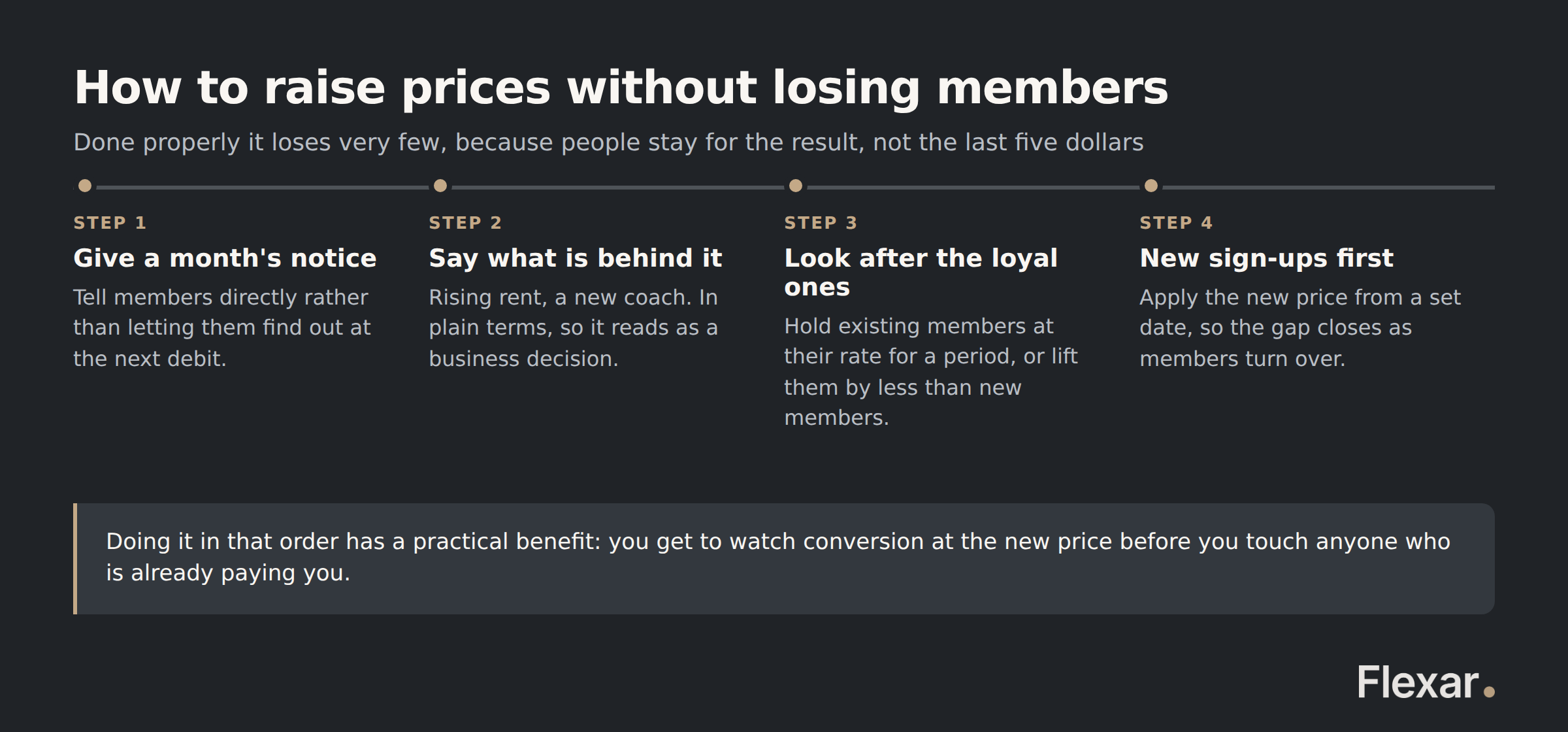
Give at least a month's notice, and tell members directly rather than letting them discover it at the next debit. Explain what sits behind the rise in plain terms, such as rising rent or a new coach, so it reads as a business decision rather than an opportunistic one. Consider holding existing members at their current rate for a period, or lifting them by less than new members, which recognises the people who have been there longest.
Apply the new price to new sign-ups from a set date, so the gap closes naturally as members turn over. Doing it in that order has a practical benefit too: you get to watch conversion at the new price before you touch anyone who is already paying you.
Where software fits in pricing
Most of pricing is judgement, but the two parts that trip owners up are the parts software should be handling.
Flexible billing lets you run pro-rata joins and fair freezes without doing the arithmetic by hand, so a member who joins on the 14th or pauses for a week is charged correctly and has nothing to argue about at the desk. Reporting shows your average revenue per member and which tier people actually pick, which turns a price change into something you can measure inside a quarter instead of something you guess at.
If you are weighing up platforms, the best gym management software in Australia covers how the category compares on billing, fees and contracts. And since pricing and cancellations are closely related, how to reduce gym churn covers the attendance side of the same problem.
Key takeaways
- Price from your own numbers rather than the gym down the road. Your cost per member is the floor, the value of your result is the ceiling, and your price belongs between them.
- Plan around average revenue per member, which is total membership revenue divided by member count. It ties your price, your model and your member numbers into one figure you can steer.
- Keep to two or three tiers built as good, better, best, with the middle tier the one you want people on and the top tier there to make it read well.
- The $77 national average is roughly $18 a week and is weighted by the budget chains, so a coached studio is not competing with it.
- One in four Australian gym members attend less often than they planned to, so an unlimited model needs someone watching attendance, not just billing.
- Review pricing every quarter against conversion, revenue per member and churn, and raise prices in small regular steps rather than one large jump.
Key facts
- Australians spend an average of $77 a month on gym memberships, up from around $63, according to Canstar research published in March 2026 covering more than 1,300 gym-goers. That is roughly $18 a week, and it is a whole-of-market average weighted by the budget chains.
- Australian gyms quote weekly. Budget 24/7 chains sit around $10 to $20 a week, mid-tier and coached gyms around $40 to $60, and premium or boutique from $80 upwards.
- Nearly half of Australian gym members, 48%, train three to four times a week.
- One in four Australian gym members say they attend less often than they planned to when they joined.
- Average revenue per member equals total membership revenue divided by member count, and it is the single number to plan pricing around.
- Two or three tiers convert better than five or six, because every extra option adds a decision and some members respond by choosing nothing.
Price with confidence, and bill it cleanly
Good pricing only holds if the billing behind it is fair and the numbers are easy to read. See how Flexar handles pro-rata billing, fair freezes and revenue reporting on the Flexar pricing page and the features page. If you want to try it on your own members, the 30-day free trial needs no card.
Joel Miranda is the founder of Flexar, gym management software built for Australian gyms, studios and CrossFit boxes.
Published 9 August 2026.
Common questions
How much should I charge for a gym membership in Australia?
It depends on your costs and what you deliver, not on the gym nearby. Work out your cost per member as a floor, estimate what members will pay for your result as a ceiling, and set a price between them. As context, Australians spend an average of $77 a month on gym memberships.
What is the best gym membership pricing model?
There is no single best model. Unlimited monthly suits gyms that want regular attendance and predictable revenue, class packs suit studios where members train once or twice a week, and tiers let members self-select by budget and use. Many gyms combine a monthly membership with a casual or pack option.
How many membership tiers should I offer?
Two or three. One price leaves money on the table, and more than three makes the choice harder, so conversion tends to fall. Build them as good, better and best, with the middle tier the one you most want members to pick.
Should I use lock-in contracts or month-to-month?
Month-to-month with no lock-in usually converts more new members because it removes the fear of being trapped. A contract gives you more certainty but can put off sign-ups. How you handle freezes and cancellations affects churn as much as the contract length.
How do I raise gym membership prices without losing members?
Give at least a month's notice, tell members directly, and explain the reason in plain terms. Consider holding existing members at their current rate or raising them by less than new members, and apply the new price to new sign-ups first so you can watch conversion before moving everyone.